Nutrition
How do you build dairy-free vegetarian protein meals in India?
Build dairy-free vegetarian meals around dal, chana, rajma, soya chunks, tofu or tempeh. Weigh dry pulses before cooking and use the pack label for soy products. You can estimate each portion’s protein from those ingredient weights, then divide a shared batch into the portions you eat.
Which foods should you start with?
Choose a measured portion of pulses or a soy product you enjoy eating. Use the food’s stated weight and preparation state to calculate its contribution.
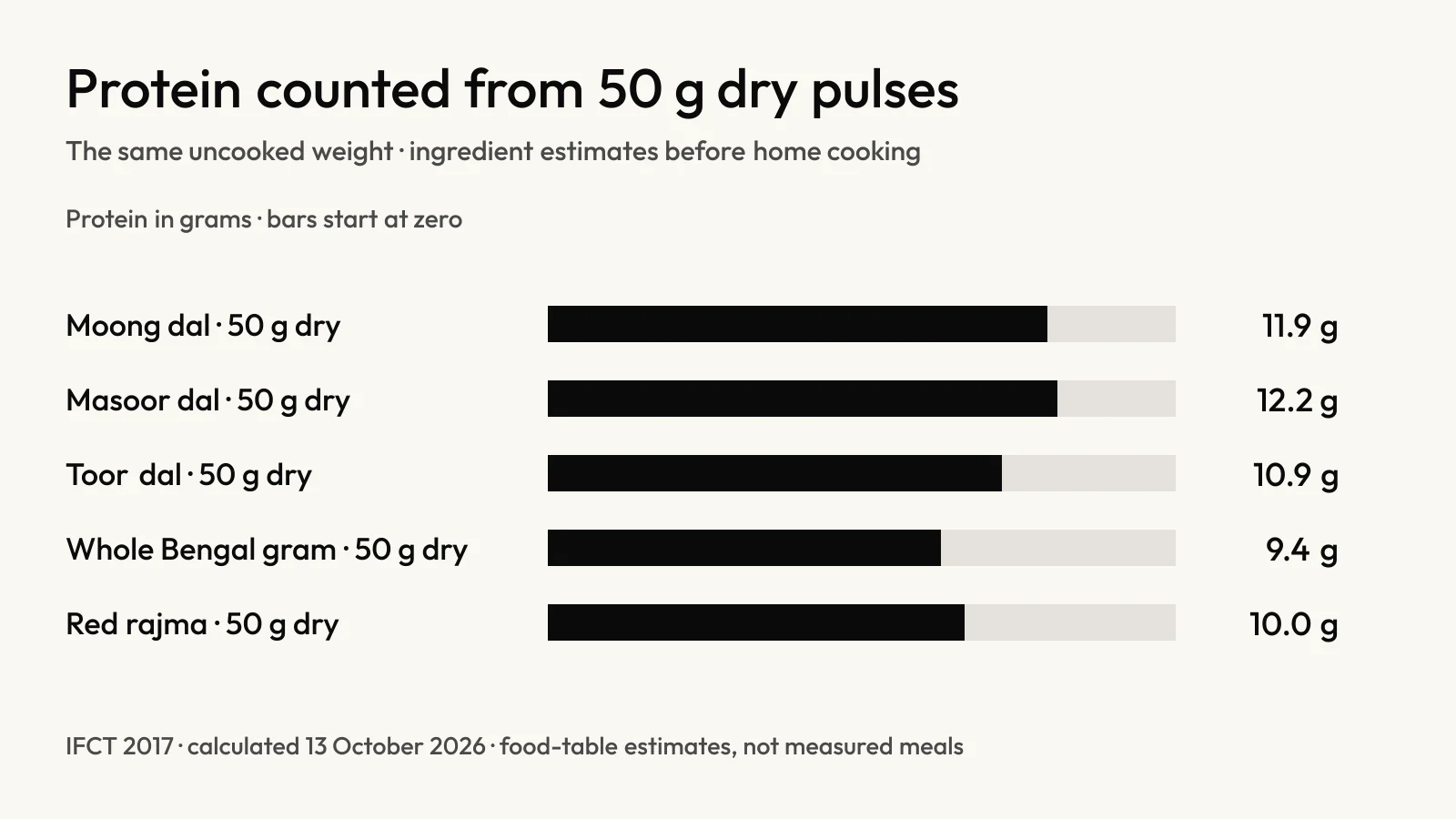
The ICMR-NIN Indian Food Composition Tables, 2017 report values per 100 g edible portion. The named pulse entries below describe raw, uncooked ingredients. Use the preparation state attached to each entry.
| Food | Basis | Protein per 100 g | Example weight | Calculated protein |
|---|---|---|---|---|
| Moong dal | Dry, uncooked | 23.88 g | 50 g | 11.9 g |
| Masoor dal | Dry, uncooked | 24.35 g | 50 g | 12.2 g |
| Toor dal | Dry, uncooked | 21.70 g | 50 g | 10.9 g |
| Whole Bengal gram | Dry, uncooked | 18.77 g | 50 g | 9.4 g |
| Red rajma | Dry, uncooked | 19.91 g | 50 g | 10.0 g |
| Fortune Mini Soya Chunks | Dry product | 52 g | 40 g | 20.8 g |
| Hello Tempayy Natural Tempeh Cubes | Packaged food, before home cooking | 21 g | 100 g | 21 g |
Sources: IFCT Table 1, printed pages 4–5; Fortune’s product information; Hello Tempayy’s nutrition-label image. Example weights are calculation choices, rather than prescribed portions.

Check the label on your own pack. Hello Tempayy’s webpage also contains a comparison table showing 19 g protein per 100 g, while its nutrition image shows 21 g. We used the nutrition image for this example. A different product or pack needs its own calculation.
You can use tofu in a bhurji, curry or chilla filling. Urban Platter describes tofu as soybean curd, made by curdling soy milk and pressing the curds. Check your tofu’s label before assigning it a protein amount. Replacing paneer with an equal weight of tofu does not give you enough information to calculate the meal.
How do you compare dry dal with cooked food?
Use the preparation state specified by the source. Apply a dry-food value to the dry ingredient weight that went into your recipe.
A bowl of cooked dal does not tell you how much dry dal the cook used. Record that amount before adding water. Keep the same approach for rice, atta and soya chunks.
The calculation is:
Protein estimate = ingredient weight in grams × protein per 100 g ÷ 100.
For a shared pot, add the estimates for the ingredients you counted, then divide by the portions you serve. If you divide a pot into four equal portions, assign one quarter of its calculated ingredient protein to each portion.
Keep the food name beside the number. “50 g dry moong dal” gives you a reproducible starting point. “One bowl of dal” leaves the bowl size and recipe unspecified.
These are ingredient-based estimates. The source values do not measure your finished dish or the protein your body absorbs. ICMR-NIN notes that foods vary in composition and that processing affects food components. Use the calculation to make your planning more consistent, while keeping that uncertainty visible.
The food-logging guide explains how to describe quantities and check the entry you save.
Which Indian meal combinations can you use?
The five combinations below provide calculated estimates of 21.3–35.3 g protein from their listed ingredients. Choose one that fits your food preferences and the portion you want to eat.
| Meal idea | Listed ingredients for one example portion | Calculated ingredient protein |
|---|---|---|
| Soya pulao | 40 g dry soya chunks + 50 g dry rice | 24.8 g |
| Masoor and soya dal | 50 g dry masoor dal + 25 g dry soya chunks | 25.2 g |
| Moong-rice khichdi | 75 g dry moong dal + 50 g dry rice | 21.9 g |
| Rajma with roti | 75 g dry red rajma + 60 g atta | 21.3 g |
| Moong chilla with tempeh | 60 g dry moong dal + 100 g Natural Tempeh Cubes | 35.3 g |
Method: the table uses the sources above, plus IFCT entries for raw milled rice and atta. It counts only the named ingredients, before home cooking. It excludes vegetables, sauces and other additions.
For the pulao example, the arithmetic is:
40 × 52 ÷ 100 + 50 × 7.94 ÷ 100 = 24.77 g, rounded to 24.8 g.
You can prepare the soya using the pack instructions, then add it to your rice recipe. Fortune’s instructions describe rehydrating its mini chunks in boiling water or broth for 10–15 minutes.
For the masoor option, cook your usual dal and add the prepared soya chunks. For chilla, use the measured moong in your batter and serve the tempeh beside it or as a filling. Follow the product’s cooking instructions.
Add vegetables and your usual seasonings to the meal. Count other ingredients from their own sources if you want a fuller nutrition estimate. Use the calorie-target guide to place the meal within your day.
Can you use these ideas without soy?
You can choose the moong-rice khichdi or rajma-and-roti examples without using a soy ingredient. Recalculate the meal when you replace an ingredient.
Start with the food you already cook. A measured batch of khichdi may be easier to repeat than a new recipe with an unfamiliar product. Keep the dry dal and rice amounts in the recipe note so you can make the same batch again.
For a different pulse, use that pulse’s composition value. A swap changes the arithmetic even if you keep the ingredient weight unchanged. You can also change the ratio of pulse to grain, then calculate the revised combination.
Choose a portion you can eat with comfort. You do not need to eat all five examples or copy the largest example portion.
How much protein should the whole day contain?
Set a daily target suited to you, then choose meals that contribute towards it. The meal table gives examples of ingredient quantities; it does not set your daily requirement.
For healthy adults who exercise, the 2017 ISSN position stand on protein and exercise gives a range of 1.4–2.0 g protein per kilogram of bodyweight per day for most exercising individuals. Keep that population in mind when using the range.
The calorie and protein guide covers daily targets. Once you have a suitable number, total the portions you plan to eat across your meals.
Use personal advice from a doctor or registered dietitian if you are under 18, pregnant or breastfeeding, have a medical condition or a history of disordered eating, take regular medication, or follow a prescribed diet. Those circumstances need more than an example menu.
How do you handle shared cooking?
Give whoever cooks the ingredient weights and the number of portions. Specify dry or cooked beside the weight, and name any dairy ingredients you want to leave out.
For a family pot, write the batch quantities first. Add a separate note for your share. You can use a kitchen scale to divide the finished dish if equal ladles or bowls do not give you the portions you intended.
Ask about yoghurt in marinades, cream in gravy and ghee or butter added during cooking. Agree on the ingredients before calculating the meal. Keep that information with the recipe so you can repeat it.
For packaged sauces and other additions, read both the ingredient list and the nutrition information. The FDA’s serving-size explanation illustrates the arithmetic: eating two stated servings doubles the listed nutrient amount. Apply the amount and basis printed on the product you use.
Do you need a protein powder?
Food can provide the protein that healthy exercising adults need. The food-only protein calculation covers that wider question; use the ingredient weights here for the dairy-free meal examples.
First total the portions you eat. If you choose a powder, calculate its contribution from its label and check its ingredients against your dietary requirements. A scoop size and a protein amount are separate numbers.
Use the supplement-limits guide for supplement safety information rather than adding doses from several products without checking them.
Which sources support this answer?
IFCT supplies the raw-food values, and first-party labels supply the named soy-product examples. ISSN defines the training-protein range; FDA illustrates serving arithmetic. These sources do not measure the finished meals.
- Longvah et al. (2017). Indian Food Composition Tables. Table 1, A015, A019, B002, B010, B013, B020 and B021; raw edible ingredient values.
- Fortune Mini Soya Chunks. First-party dry-product protein information and preparation instructions. Read 13 October 2026.
- Hello Tempayy Natural Tempeh Cubes nutrition image: 21 g protein per 100 g. Read 13 October 2026; the webpage comparison table differs at 19 g, so check your own pack.
- Hello Tempayy Natural Tempeh Cubes product page, including the differing comparison table. Read 13 October 2026.
- Urban Platter. The curious case of tofu: history. Tofu as soybean curd; no generic protein amount taken from this page.
- Jäger et al. (2017). International Society of Sports Nutrition Position Stand: protein and exercise. Healthy exercising adults; 1.4–2.0 g/kg/day and whole-food feasibility. PubMed 28642676.
- US Food and Drug Administration. Serving Size on the Nutrition Facts Label: two servings double the listed nutrient amount.
- Liftor daily meal-plan PDF: approved site src/lib/content/facts.ts and the meal-plan-sharing guide.
Topic: Dietary protein. Dairy-free vegetarian meals using named dry ingredients, product labels and shared-batch calculations.
Liftor can export your daily meal plan as a PDF for whoever cooks. Follow the meal-plan sharing steps, or Download for iPhone.
Liftor is not a doctor and gives no medical advice.