Nutrition
Can you build muscle without protein powder?
Yes. You can build muscle without protein powder by combining resistance training with enough protein from food. The ISSN’s 2017 position stand says healthy exercising adults can meet their protein requirements through whole foods. The worked Indian food example below supplies about 106 g. That is a calculation, not a promise of muscle gain.
Do you need a protein supplement to build muscle?
Protein powder is a dietary supplement that supplies protein. It is optional when your food supplies the protein you need.
Check your food intake and training programme before choosing it for convenience.
The International Society of Sports Nutrition’s 2017 position stand on protein and exercise recognises both whole-food feasibility and the convenience of supplementation for healthy exercising people.
India’s ICMR-NIN gives food-first advice in its 2024 Dietary Guidelines for Indians. Guideline 8 says: “Most athletes can get the recommended amount of protein through food alone, without the use of supplements.” It also pairs protein intake with resistance exercise and adequate energy from the rest of the diet.
You do not have to choose a permanent side. Start by checking a few ordinary days of eating. If you enjoy the meals, can prepare them and can meet your needs with food, a supplement adds another decision. If you struggle to do that, a registered dietitian can help you compare suitable options.
How much protein should you count from food?
The ISSN’s 2017 position stand gives 1.4–2.0 g of protein per kilogram of bodyweight per day as sufficient for most healthy exercising adults. Count the whole day’s food towards that total; it is not an amount to add on top of meals.
For a 70 kg adult, the calculation is 70 × 1.4 = 98 g and 70 × 2.0 = 140 g per day. That range describes the population covered by the position stand. It cannot set a personal target for someone with different health or nutrition needs.
Use the calorie and protein target guide for the wider question of setting a starting target and following a weight trend.
Write down the reference you are using before you count meals. Otherwise you can collect numbers from several websites and chase whichever one is largest. Keep kilograms and grams separate: bodyweight goes into the multiplication; grams of protein come out.
How can you get 100 g of protein without powder?
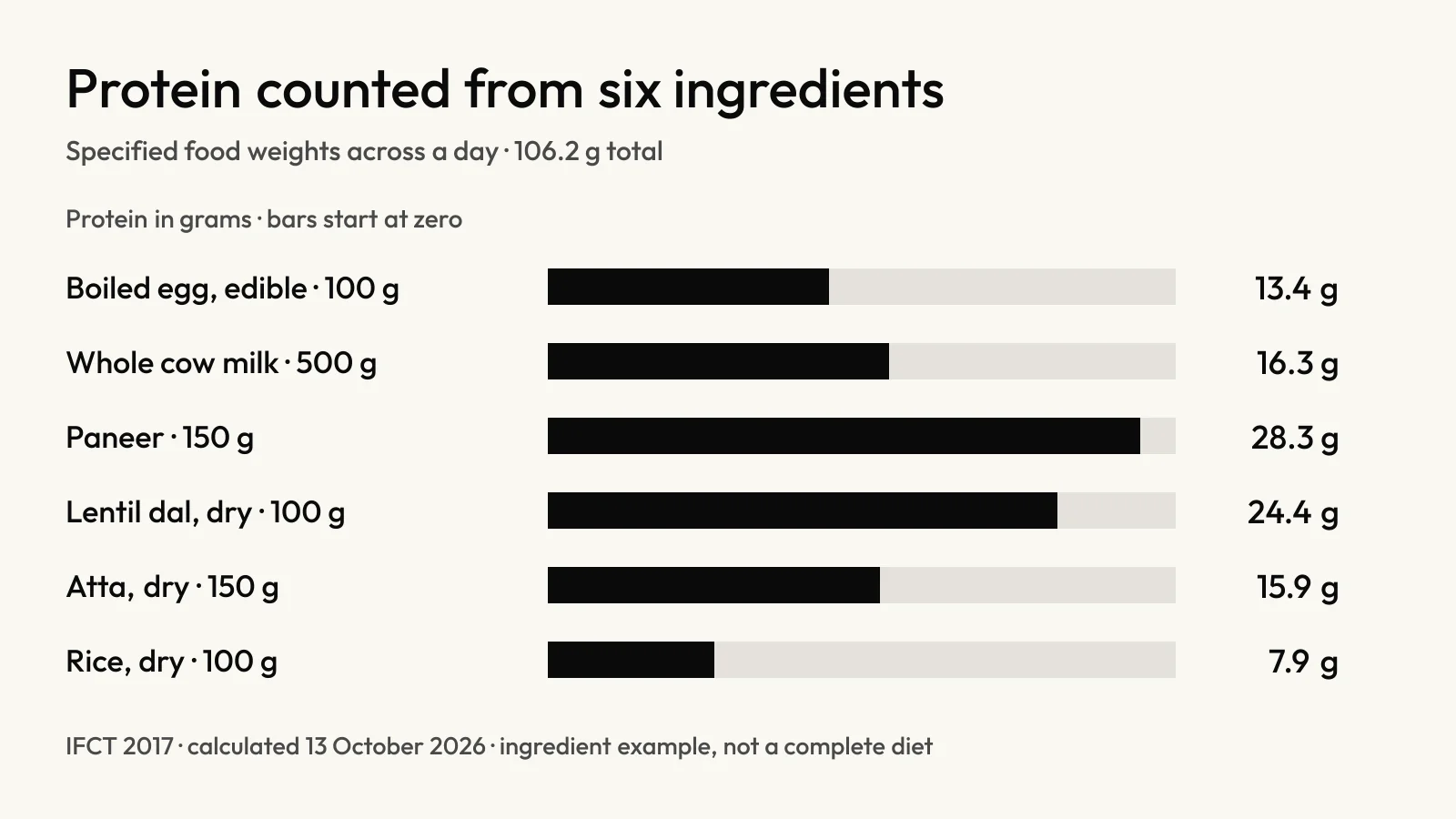
The six weighed ingredients below supply an estimated 106.2 g of protein across a day. This example uses eggs and dairy, so it is neither vegan nor a dairy-free plan.
We calculated it on 13 October 2026 from the National Institute of Nutrition’s Indian Food Composition Tables, 2017, Table 1. Each row names the food code, weight and protein value used. The weights describe the stated food form, rather than a guessed bowl size.
| Food and IFCT code | Amount across the day | Protein per 100 g | Protein counted |
|---|---|---|---|
| Boiled poultry egg, M004 | 100 g edible portion | 13.43 g | 13.43 g |
| Whole cow milk, L002 | 500 g | 3.26 g | 16.30 g |
| Paneer, L003 | 150 g | 18.86 g | 28.29 g |
| Lentil dal, B013 | 100 g dry | 24.35 g | 24.35 g |
| Atta, A019 | 150 g dry | 10.57 g | 15.86 g |
| Milled rice, A015 | 100 g dry | 7.94 g | 7.94 g |
| Total | 106.17 g |
For each row, protein = food weight × protein per 100 g ÷ 100. We sum the unrounded results and round at the end. The table’s two-decimal display does not make your dinner accurate to two decimal places.
The IFCT energy values total 8,910 kJ. Using the thermochemical conversion of 4.184 kJ per kcal gives about 2,130 kcal, before vegetables, fruit, oil or other additions. This is a protein-counting example, not a complete meal plan or a calorie target. Make room for the rest of your diet and choose portions that fit your needs.
You could split the milk between breakfast and an afternoon drink, and divide the dal and paneer between lunch and dinner. Use the atta for the rotis you make across the day. Choose the timing around your kitchen and work rather than trying to copy an exact schedule.
How should you weigh dal, rice and roti?
Match the food’s preparation state to the value you use. In this example, weigh dal, rice and atta before cooking; weigh the boiled egg without its shell.
Suppose you cook 100 g of dry lentil dal and divide that batch into two equal portions. The calculation assigns half the batch’s estimated 24.35 g of protein to each portion: about 12.2 g. We have not treated 100 g of cooked dal as 100 g of dry lentils.
For rotis, record the flour used for the batch and the share you ate. Writing “two rotis” leaves the flour amount open. For paneer or milk with a nutrition label, use the label for that product instead of assuming it matches a national table’s average. The homemade-meal logging method explains how to keep those recipe details together.
Keep the same method next time you make the dish. You can then compare like with like without weighing a recipe from the beginning each day. If someone else cooks, agree on the batch quantities and your share; the meal-plan sharing guide covers communicating portions to whoever prepares the food.
Are two eggs enough protein for muscle gain?
Two eggs are one part of a day’s protein intake. Their protein contribution depends on their edible weight, and the rest of your meals still count.
IFCT’s boiled poultry egg entry supplies 13.43 g per 100 g of edible egg. If your two peeled eggs together weigh 100 g, that is the amount in this example. Different egg sizes change the arithmetic.
For the illustrative 70 kg adult’s 98–140 g range, those eggs leave about 85–127 g to come from the rest of the day. That subtraction does not tell you to eat more eggs. Check the other foods you already eat before changing breakfast.
Use the same approach for a bowl of dal, a glass of milk or a portion of chicken: name the food, record the amount and include it in the whole-day count. One food does not need to carry the target by itself. You can choose several foods you tolerate and like, then check the combined total.
Can vegetarians do this without dairy or eggs?
A food-only approach can include plant foods. ICMR-NIN’s 2024 guidance explains that a varied combination of cereals, pulses, nuts and seeds can provide the essential amino acids a vegetarian diet needs.
The example table above includes dairy and eggs, so deleting those rows changes the total. It is not a ready-made vegan menu. Replace the ingredients you avoid, then calculate the replacement portions instead of keeping the old headline number.
Use a food entry or packet label that matches your chosen product. Tofu, cooked beans and a dry soy product are different entries with different water contents and portions. Calling all three “one serving of plant protein” leaves too much room for an estimate.
The dairy-free vegetarian protein calculation uses a separate set of ingredients. See the Nutrition topic for food and portion guides. A registered dietitian can help you build a varied plan if several food restrictions make it hard to eat enough. The aim is a workable set of meals, with the protein count as one check on it.
Do you need a protein shake after training?
You do not need a shake to meet a food-only protein target. Plan a protein-containing meal that fits your day, and count that food with the rest of your intake.
The ISSN position stand recognises benefits from protein before or after resistance exercise and individual tolerance when choosing timing. Arrange meals around the session you can attend and the food you can prepare.
If your plan leaves a long stretch without a chance to eat, organise a suitable meal before you leave or after you return. Check the ordinary food options available to you rather than relying on a rule copied from a supplement label.
What should you track if you train without supplements?
Track food quantities in a meal record and completed exercise in a training log. Use both records when you review your routine.
- Record a few representative food days, including a busy day. Use the food form and quantity rather than the dish name alone.
- Count the existing protein before you add a new food. Choose changes you can prepare and repeat.
- Record the exercise, load and completed reps in your training log. Compare familiar exercises over time.
- Change one practical part of the routine at a time, so you can see whether you can keep doing it.
Use the progressive overload guide for the training method and the RPE and reps-in-reserve guide for recording effort. If a holiday interrupts your routine, the week-off-the-gym article separates break length from what the research measured.
Who should get advice before changing protein intake?
Ask a doctor or registered dietitian before using a general training-protein range if you have a medical condition or a prescribed diet. ICMR-NIN’s 2024 guidance identifies existing kidney disease as a reason to take care with high protein intake.
This article’s range and example apply to general information for healthy adults. They are not a nutrition prescription for children, pregnancy or breastfeeding, or for managing a health condition. Get individual advice if food restrictions, poor appetite or a history of disordered eating make changes difficult.
If you decide to use supplements, read the supplement upper-limits guide before combining products. That guide covers mineral and stimulant limits; the protein calculation here does not check the rest of a supplement’s ingredients.
Which sources support this answer?
The sources below support the protein guidance and the food calculation; none promises a particular muscle gain from this example.
- Jäger et al. (2017). International Society of Sports Nutrition Position Stand: protein and exercise. Healthy exercising adults, 1.4–2.0 g/kg/day and whole-food feasibility. PubMed 28642676.
- ICMR-NIN (2024). Dietary Guidelines for Indians. Guideline 8, printed pages 57–61: food-first protein, food combinations, training, energy and existing kidney disease caution.
- Longvah et al. (2017). Indian Food Composition Tables. Table 1, A015, A019, B013, L002, L003 and M004: protein and energy in the named food states.
- NIST Guide to the SI, footnotes 9–11: thermochemical calorie conversion, 4.184 joules per calorie.
Topic: Dietary protein. Counting protein from weighed foods alongside resistance training, with the limits of a food-table example.
Liftor is not a doctor and gives no medical advice.