Nutrition
Should you eat protein before or after a workout?
Protein before or after lifting can both fit a useful meal plan. Start with enough protein across the day, then choose the timing from your last meal, the session and your next chance to eat. A 2025 review of direct comparisons found no clear difference in lean-mass gains between the two timings.
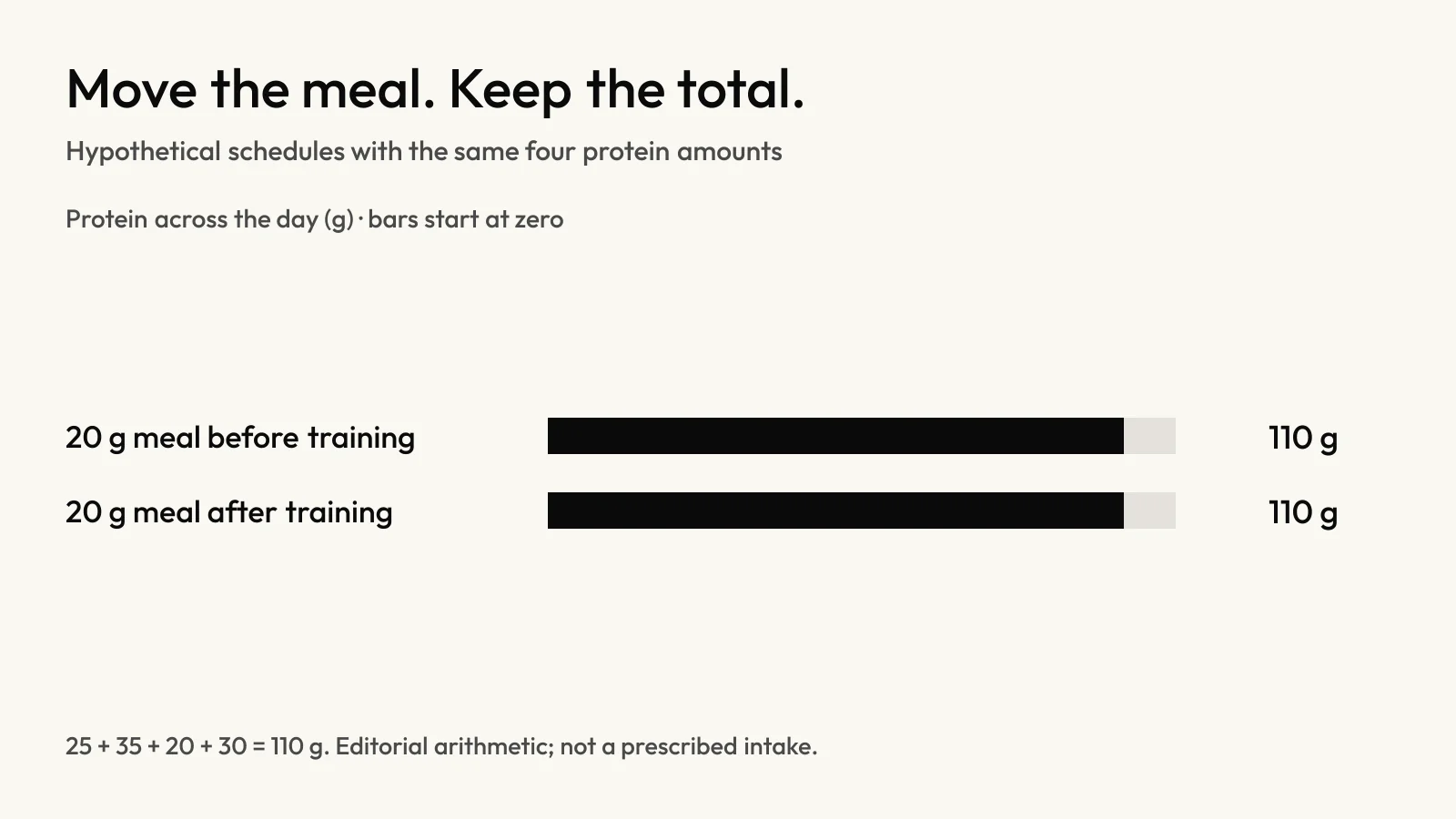
Move the meal. Keep the total.
Hypothetical schedules with the same four protein amounts
Protein across the day (g) · bars start at zero
- 20 g meal before training110 g
- 20 g meal after training110 g
25 + 35 + 20 + 30 = 110 g. Editorial arithmetic; not a prescribed intake.
What does the research say about before and after?
The 2025 direct-comparison review found no clear difference in lean-mass gains between protein before and after exercise. Casuso and Goossens included six reports from five studies lasting at least four weeks. Read the direct-comparison review.
For lean body mass, the pooled standardised difference was −0.08, with a 95% confidence interval from −0.398 to 0.244. That interval includes no difference. It also leaves uncertainty; the result cannot prove that timing has identical effects for every person or training programme.
The review found a leg-press strength result favouring protein before exercise, while chest-press results did not show a clear difference. The comparison between those limb subgroups was itself inconclusive. The authors call for more investigation. This small evidence base cannot support a rule that everyone needs protein at one precise time.
One included 2017 trial followed 21 trained men for ten weeks, with 25 g protein before or after their sessions. The groups showed no significant differences in the measured adaptations. Its size and population limit what you can infer for women, older adults or people with different diets. Read the 2017 trial.
The trial’s authors set out to test the “anabolic window”, the idea that protein must follow training within a narrow period. They concluded that the interval for protein intake may be as wide as several hours or more after a session, depending on when the meal before it was eaten.
How much does the daily protein total matter?
Check the whole day before moving a meal by thirty minutes. The 2017 ISSN position stand gives a general daily range of 1.4–2.0 g protein per kilogram of bodyweight for most healthy exercising people. Read the ISSN protein position stand.
For a hypothetical 70 kg adult, that range calculates to 98–140 g a day: 70 × 1.4 and 70 × 2.0. It is general sports-nutrition guidance, with individual needs and medical diets outside this example. It is not an instruction to reach the upper number.
Write down meals you already eat, including ordinary food. A day that repeatedly omits a protein-containing meal needs a different decision from a day whose meals already meet an appropriate target. Use the calorie-target guide for the separate task of planning overall intake, and food options without protein powder for a weighed food example.
What happens if you move the same meal around training?
Moving a meal changes its timing. Adding a meal changes both timing and total intake. Keep those two comparisons separate when you decide what helped you follow the plan.
The following day is hypothetical. Its protein amounts are chosen inputs, not food-label measurements or a recommended diet. Both versions have the same 18:00–19:00 workout and the same four amounts.
| Meal | Before version | After version |
|---|---|---|
| Breakfast | 08:00 · 25 g | 08:00 · 25 g |
| Lunch | 12:00 · 35 g | 12:00 · 35 g |
| Moved meal | 16:30 · 20 g | 19:15 · 20 g |
| Dinner | 20:30 · 30 g | 20:30 · 30 g |
| Daily total | 110 g | 110 g |
Method: 25 + 35 + 20 + 30 = 110 g in each column. Moving the 20 g amount changes the total by 0 g. Eating it at both times would make 130 g, which would no longer be a matched-total comparison.
This table isolates one planning choice. It does not predict muscle growth, test digestion or establish an ideal meal spacing. You could choose a more convenient arrangement, including putting the moved food into dinner, while checking the day as a whole.
How do you use the last meal and next meal to choose?
Put the meals and workout on a clock, then look for a practical place to eat. “After training” can describe a meal fifteen minutes later or several hours later, so the words alone leave out useful information.
| Situation | Stated times | Planning decision |
|---|---|---|
| Meal before an evening session | Protein meal 16:30; lift 18:00–19:00; dinner 20:30 | Meal is 90 minutes before starting; dinner is 90 minutes after finishing. Keep a workable routine. |
| Early session after the night | Dinner 20:00; lift 07:00–08:00; breakfast 08:30 | Dinner is 11 hours before starting; breakfast is 30 minutes after finishing. Plan breakfast rather than leaving the next meal undefined. |
| Long delay after a morning session | Lift finishes 08:00; next meal planned at 13:00 | The delay is five hours. Consider an earlier ordinary meal or convenient food if it suits you. |
These intervals are arithmetic from the stated clock times. They are not biological cut-offs. The ISSN stand describes protein before or after exercise as useful and suggests distributing protein servings through the day. It does not make this table’s thirty-minute breakfast a deadline. The stand treats the best timing as likely a matter of individual tolerance, and describes the anabolic effect of exercise as lasting at least 24 hours, though likely diminishing as time passes.
Should you eat before an early-morning workout?
Choose an arrangement you can tolerate and repeat, with the next meal planned. A small familiar meal before training and breakfast afterwards is one option; training first and having breakfast afterwards is another practical schedule. Carbohydrate and fluids before a long or hard session are a separate fuelling decision from protein timing; ask a registered dietitian if you need a plan for them.
If eating close to exercise feels uncomfortable, give yourself more time or choose a different familiar food. Avoid testing a large unfamiliar meal on a morning when your session and commute are fixed. This is a scheduling choice, not a reason to force a fast or skip food later.
Write the actual times for one morning. A 06:30 breakfast before a 07:30 session is a one-hour gap. A breakfast at 09:00 after an 08:30 finish is a thirty-minute gap. Keep your food choice and daily amount visible as well as the time; changing several things together makes the comparison harder to interpret.
Do you need a shake around the workout?
You can use ordinary protein-containing foods. A shake is a convenient food option when it fits your preferences and needs; the timing studies do not make powder a requirement for taking part in strength training.
In an Indian routine, you might plan eggs, milk or curd if you eat them, or a meal with soya, pulses or another suitable protein source. Match the choice to your diet, allergies and storage arrangements. This list gives options rather than assigning equal protein amounts to different portions.
Check the portion and label when you need a number. The homemade-meal recording method separates ingredient amounts from cooked portion weights. For dairy-free options, use the dairy-free vegetarian meal examples. A meal name alone cannot tell you its protein total.
Should you spread protein across several meals?
A workable daily pattern is a useful starting point. The ISSN stand suggests general servings of about 20–40 g, or roughly 0.25 g/kg, spaced around three to four hours apart for healthy exercising people. These are general guidance ranges rather than a timer you must obey.
For a 70 kg example, 0.25 g/kg calculates to 17.5 g. That illustrates why a bodyweight calculation and a rounded general serving range can differ. Individual circumstances affect the amount; do not turn either expression into a universal minimum at each meal.
The matched-day table above isolates a timing change, so it deliberately keeps the original meal amounts. It does not claim to model the stand’s suggested distribution. If you want help planning a full diet, take your usual meals and training times to a registered dietitian rather than treating one example day as your prescription.
Who should get individual advice before changing intake?
Ask your doctor or registered dietitian before changing protein intake if you have a medical condition, a prescribed diet or concerns about what you should eat. General sports-nutrition ranges cannot account for those circumstances. NIDDK guidance for people with kidney disease explains why protein advice can need an individual balance.
Keep the question specific: your usual meals, the timing of exercise and the change you are considering. You do not need to buy a supplement or follow an exact clock time to ask it. If counting food causes distress or rigid rules, seek individual support instead of adding more targets.
For your next routine session, choose the food and time in advance and check whether the arrangement fits. Record a change you can observe, such as having breakfast before leaving for work. A single session cannot tell you whether muscle growth changed.
Which sources support this answer?
The direct-comparison review and trial address timing. The ISSN position stand addresses intake for healthy exercising adults. The meal schedules below are labelled editorial examples, not observed diets or prescriptions.
- Casuso RA and Goossens L (2025). Does Protein Ingestion Timing Affect Exercise-Induced Adaptations? Six reports from five studies directly comparing pre- and post-exercise protein.
- Schoenfeld BJ et al. (2017). Pre- versus post-exercise protein intake has similar effects on muscular adaptations. Ten-week trial in 21 resistance-trained men.
- Jäger R et al. (2017). International Society of Sports Nutrition Position Stand: protein and exercise. Guidance for healthy exercising people.
- NIDDK. Healthy Eating for Adults with Chronic Kidney Disease: individual protein advice from a healthcare professional or dietitian.
Topic: Protein timing. Protein meals around resistance exercise, daily intake and the limits of direct timing comparisons.
For a daily meal plan alongside your training, Download for iPhone.
Liftor is not a doctor and gives no medical advice.