
Nutrition
What vegetarian protein food can you take on a train?
Sealed packs of groundnuts, pistachios, almonds, cashews or sunflower seeds labelled for room-temperature storage need no fridge; India’s food composition tables (IFCT 2017) give 7.1 g of protein in 30 g of groundnuts. Paneer, curd, milk and cooked dishes need cold storage: FDA limits perishable food to two hours at room temperature.
Updated: Added IFCT 2017 protein and energy values for nuts, seeds, paneer and milk, a roasted-chana label, FDA’s cold-storage list, USDA’s hot-food method, FDA’s take-out rule for station meals and named foods in the trip plan. The portion arithmetic now uses IFCT values.
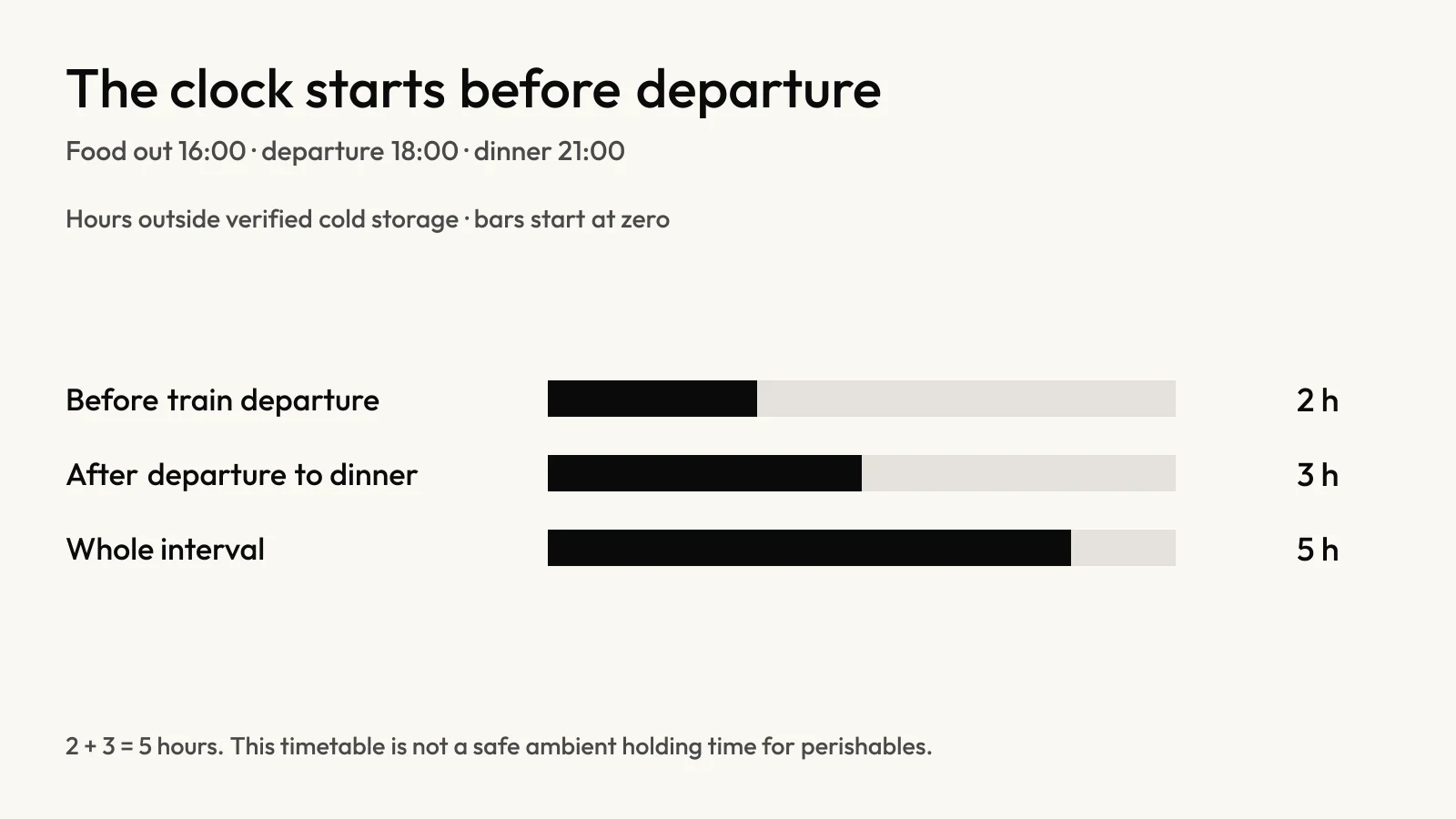
The clock starts before departure
Food out 16:00 · departure 18:00 · dinner 21:00
Hours outside verified cold storage · bars start at zero
- Before train departure2 h
- After departure to dinner3 h
- Whole interval5 h
2 + 3 = 5 hours. This timetable is not a safe ambient holding time for perishables.
Which vegetarian protein foods need no fridge?
Dry, sealed foods: groundnuts, pistachios, sunflower seeds, almonds and cashews, in packs whose labels allow storage at room temperature. A peanut-butter sandwich and whole fruit also travel; USDA lists peanut butter, breads, crackers and whole fruits among items that don’t require refrigeration. Read the USDA packing guidance.
| Food (IFCT code) | Protein per 100 g | Protein in 30 g | Energy in 30 g |
|---|---|---|---|
| Groundnuts (H012) | 23.65 g | 7.1 g | 156 kcal |
| Sunflower seeds (H020) | 23.53 g | 7.1 g | 176 kcal |
| Pistachios (H018) | 23.35 g | 7.0 g | 162 kcal |
| Cashews (H005) | 18.78 g | 5.6 g | 175 kcal |
| Almonds (H001) | 18.41 g | 5.5 g | 183 kcal |
Method: values come from ICMR-NIN’s Indian Food Composition Tables 2017 (IFCT). Protein is the value per 100 g × 30 ÷ 100; energy is IFCT’s kilojoules × 0.3 ÷ 4.184. IFCT reports raw edible portions, so a roasted, salted or flavoured pack can differ; use the label of the pack you carry. Thirty grams is an example weight, not a recommended portion. IFCT 2017, Table 1, printed pages 17 and 18.
These foods are energy-dense for the protein they give: 30 g of almonds is 183 kcal for 5.5 g of protein. IFCT 2017 has no entry for roasted chana or makhana, so use the pack label for those.
One roasted-chana label, Jabsons White Salted, gives 6 g of protein and 130 kcal for its 30 g serving, or 19 g and 420 kcal per 100 g, and says to store the pack in a cool, dry place. That is about the protein of 30 g of almonds for 53 kcal less. The no-cook hostel article works through the same label. Check each pack’s allergen statement, and leave out any nut or seed you react to.
Which vegetarian protein foods need cold storage?
Paneer, curd, milk and cooked dishes such as a paneer bhurji wrap need cold storage. FDA names dairy products, eggs, leftovers and take-out food among foods to keep cold, and its two-hour limit applies to food that needs refrigeration.
| Food (IFCT code) | Protein per 100 g | Example portion | Protein in the portion |
|---|---|---|---|
| Paneer (L003) | 18.86 g | 100 g | 18.9 g |
| Milk, whole, cow (L002) | 3.26 g | 200 g | 6.5 g |
Method: IFCT 2017, Table 1, printed page 19, multiplied by the example weight. IFCT 2017 has no curd entry, so use the pot’s label. The 18.9 g in 100 g of paneer matches the protein in about 80 g of groundnuts, which travel without cooling: 18.86 ÷ 23.65 × 100 = 79.7 g. Those 79.7 g of groundnuts carry about 415 kcal, against about 305 kcal in 100 g of paneer (IFCT kilojoules ÷ 4.184).
A sealed long-life milk carton follows its own label until you open it. USDA lists hard cheese among items that do not require refrigeration; check that the cheese suits your diet and follow its label.
When does the food-storage clock start?
Count from the time perishable food leaves verified cold storage, including the trip to the station and waiting before boarding. Departure time does not reset that interval.
| Event | Time | Time since leaving cold storage |
|---|---|---|
| Food leaves verified cold storage | 16:00 | 0 hours |
| Train departs | 18:00 | 2 hours |
| Dinner planned | 21:00 | 5 hours |
| Train delayed; dinner later | 22:00 | 6 hours |
Method: 18:00 − 16:00 = two hours before departure; 21:00 − 18:00 = three hours after departure. The total is five hours. These are selected timetable inputs, not measured temperatures or a recommended holding time.
FDA guidance limits perishables at room temperature to two hours, or one hour when the air is above 90°F, about 32.2°C. It gives a refrigeration target at or below 4°C. The five-hour example exceeds the room-temperature limit; use a different meal or effective cold storage. Read FDA storage guidance.
Does a cooler bag make chilled food suitable for the whole trip?
A cooler bag forms part of a cold-storage arrangement; it does not prove that food stayed at the required temperature. Plan the cold sources and the duration, and check the food stays within its required conditions.
USDA’s packed-lunch guidance says insulated bags are best for keeping food cold and advises at least two cold sources, placed above and below the perishable food. Start with chilled food. A long train trip may outlast a lunch arrangement, so do not extend that guidance into an unverified overnight guarantee.
If you cannot verify cooling for the intended interval, keep the later part of the plan to appropriate sealed foods from the no-fridge list or another suitable meal source. FDA notes that food can make you ill even when it does not look, smell or taste spoiled, so none of those checks can clear a questionable leftover.
Can you carry hot dal or khichdi on a train?
Yes, for the first meal on board, using USDA’s method for hot lunches. Fill an insulated container with boiling water, let it stand for a few minutes, empty it, add piping hot food and keep it closed until you eat, to keep the food at 60°C or above.
USDA writes that method for soup, chilli and stew carried to school or work, and it gives no holding time for a long trip. Eat the hot meal first and keep the later meals to sealed foods that need no cooling. The ingredient-recording method works out the protein in a home-cooked dal from its raw ingredients.
How do you calculate protein in the packed portion?
Multiply the protein per 100 g by the grams you will eat, then divide by 100. Use the label value for a packaged product and IFCT for a plain food without a label.
| Packed food | Calculation | Protein |
|---|---|---|
| 30 g groundnuts, sealed pack | 23.65 × 30 ÷ 100 | 7.1 g |
| 30 g pistachios, sealed pack | 23.35 × 30 ÷ 100 | 7.0 g |
| 100 g paneer, kept cold | 18.86 × 100 ÷ 100 | 18.9 g |
| Total for this example trip | 7.1 + 7.0 + 18.9 | 33.0 g |
FDA’s serving-size explanation separates the label’s serving size from the amount you eat, so multiply by what you will eat rather than by the serving printed on the pack. Record the portion you expect to open at each meal, including any remainder you cannot store.
What changes when you open a shelf-stable pack?
Follow the instructions for the opened product. Permission to store a sealed pack at room temperature does not automatically cover the remainder after opening.
Read the opened pack’s refrigeration and use-by instructions before keeping it for tomorrow. Opened packs differ; follow the label on yours.
The hostel article explains a pantry plan and opened-pack choices in a fixed location. On a train, add the remaining hours and the cooling you will have. Two 30 g packs you can finish may suit that constraint better than one large opened bag.
How could you organise an overnight trip?
Give each planned meal a food that meets its storage requirements, then keep a sealed reserve for a delay. Plan enough food and water for the whole trip as well.
| Opportunity | Food and storage | Before leaving |
|---|---|---|
| Early meal | Hot dal in a preheated insulated container, or a paneer bhurji wrap with two cold sources | Count station travel and waiting time |
| Later meal | Peanut-butter sandwich and whole fruit | Check protein in the actual portion |
| Morning | A sealed 30 g pack of groundnuts or pistachios, with bread or fruit | Plan what happens after opening |
| Delay reserve | A second sealed pack of nuts or seeds | Keep its storage instructions and pack intact |
Avoid saving a perishable remainder you cannot keep cold.
Use the office-lunch article for a shorter packed interval. Its timetable does not establish an overnight travel limit.
Can you rely on a meal ordered at a station?
A meal bought at a station or delivered to your seat is take-out food, which FDA includes in its two-hour rule. Eat it when it arrives rather than keeping it for later, and judge how it was handled before you buy.
What should you check before leaving for the station?
Check the whole itinerary and the food in your bag together. A delay or changed departure affects the plan before the train moves.
- Write food-out, departure, meal and arrival times.
- Separate chilled and hot items from sealed foods allowed at room temperature.
- Check pack condition, storage instructions, allergens and the amount you will eat.
- Calculate protein from that amount if you need a number.
- Plan drinking water, opening utensils and a way to handle waste.
- Keep a sealed reserve and revise the plan if cooling or timings change.
If you have a medical condition, allergies or a prescribed diet, arrange suitable food and individual advice before travelling. NIDDK’s kidney-disease dietary guidance illustrates why a generic protein target cannot cover everyone. Use the calorie-target guide for the separate daily-intake question rather than turning a travel snack calculation into a full diet.
Which sources support this answer?
IFCT 2017 supplies protein and energy values for raw edible foods, and NIST the kilojoule conversion. One manufacturer’s label supplies the roasted-chana figures. Official FDA storage and label guidance supplies the cold-storage limits. USDA packing guidance supplies cold-source, hot-food and no-refrigeration advice. All train times below are hypothetical.
- Longvah T et al. (2017). Indian Food Composition Tables. ICMR-NIN. Table 1: H001, H005 and H012 (printed page 17), H018 and H020 (page 18), L002 and L003 (page 19); values per 100 g edible portion.
- NIST Guide to the SI, footnotes: the thermochemical calorie is 4.184 joules exactly.
- Jabsons. White Salted Roasted Chana nutrition, ingredient, allergen and storage label: 30 g serving with 6 g protein and 130 kcal; 19 g and 420 kcal per 100 g. Read 22 October 2026.
- US Food and Drug Administration. Are You Storing Food Safely? Refrigeration, time outside cold storage and foods that need to be kept cold. Content current as of 18 January 2023.
- USDA Food Safety and Inspection Service. Keeping “Bag” Lunches Safe. Cold sources, hot food in insulated containers, perishable foods and items that do not require refrigeration. Last updated 25 July 2025; read on 22 October 2026.
- US Food and Drug Administration. Serving Size on the Nutrition Facts Label. Serving size on the label and the amount actually eaten. Content current as of 5 March 2024.
- NIDDK. Healthy Eating for Adults with Chronic Kidney Disease. Individual dietary advice, including protein.
Topic: Food storage during train travel. Vegetarian travel-food packing, cold-chain decisions and protein arithmetic for a stated packed portion.
For meal planning alongside your training, Download for iPhone.
Liftor is not a doctor and gives no medical advice.