
Nutrition
What vegetarian hostel meals can you make without cooking?
Make vegetarian hostel meals from ready-to-eat roasted chana, bread, nut butter, whole fruit and sealed shelf-stable packs. Buy chilled foods close to eating time unless you have reliable refrigeration. Use these options alongside mess meals, and check the preparation and storage instructions on each pack.
Updated: Added a storage decision diagram for the checked long-life milk carton, including the no-fridge case.
What should you keep in a hostel pantry?
Keep foods you can eat without cooking and store under the conditions printed on their packaging. Separate dry pantry foods from products that need refrigeration after opening.
You need somewhere clean and dry to store food, drinking water and utensils you can wash. Follow hostel rules about appliances and food storage. A kettle changes your preparation options only if the hostel permits it and the food’s instructions allow that method.
| Food | Preparation check | Storage check |
|---|---|---|
| Ready-to-eat roasted chana | Choose roasted chickpeas sold for eating | Follow the pack’s dry-storage instructions |
| Bread and nut butter | Read ingredients and allergen information | Follow both labels after opening |
| Whole fruit | Wash with safe water before eating | Buy quantities you can use before spoilage |
| Shelf-stable milk or another drink | Check that the sealed product permits ambient storage | Check refrigeration requirements after opening |
| Cooked beans in a sealed pack | Check that the maker permits eating without heating | Follow instructions once you open it |
Use ready-to-eat roasted chana for this plan. Soaking dry pulses is not the preparation method used in the examples below. Leave ingredients that require cooking for a kitchen or the mess.
The real-life topic covers other situations where you need to plan around shared facilities.
Which meals can you assemble without a stove?
Choose combinations you can prepare and eat during one sitting. Add bread or another suitable carbohydrate food and fruit where those fit your appetite and the rest of your meals.
These are editorial assembly examples. We have not tested them as a complete daily diet.
- Roasted-chana plate with milk and fruit. Weigh a portion of ready-to-eat chana, wash a whole fruit and open a suitable milk pack at eating time. Follow the opened-milk storage instructions. The checked calculation below covers chana and milk; count fruit or bread separately.
- Nut-butter sandwich with a banana. Spread a measured portion of nut butter onto bread. Check both labels for ingredients and storage directions, and choose portions that fit your meal. Use your own product labels to estimate protein or energy.
- A mess meal with a pantry addition. Eat the dal, rice or roti available at the mess, then add a portion of roasted chana if it suits the meal. Keep the mess food’s uncertain quantities separate from the weighed packaged addition.
- A ready-to-eat bean plate. Open a pack of cooked beans whose instructions permit eating without heating. Add bread and washed produce. A pack that requires cooking or heating needs the facilities specified by its maker.
Rotate options according to what you can buy, tolerate and store. For meals that exclude milk products, use the dairy-free vegetarian meal examples and check each ingredient’s preparation needs.
How much protein is in the checked chana-and-milk example?
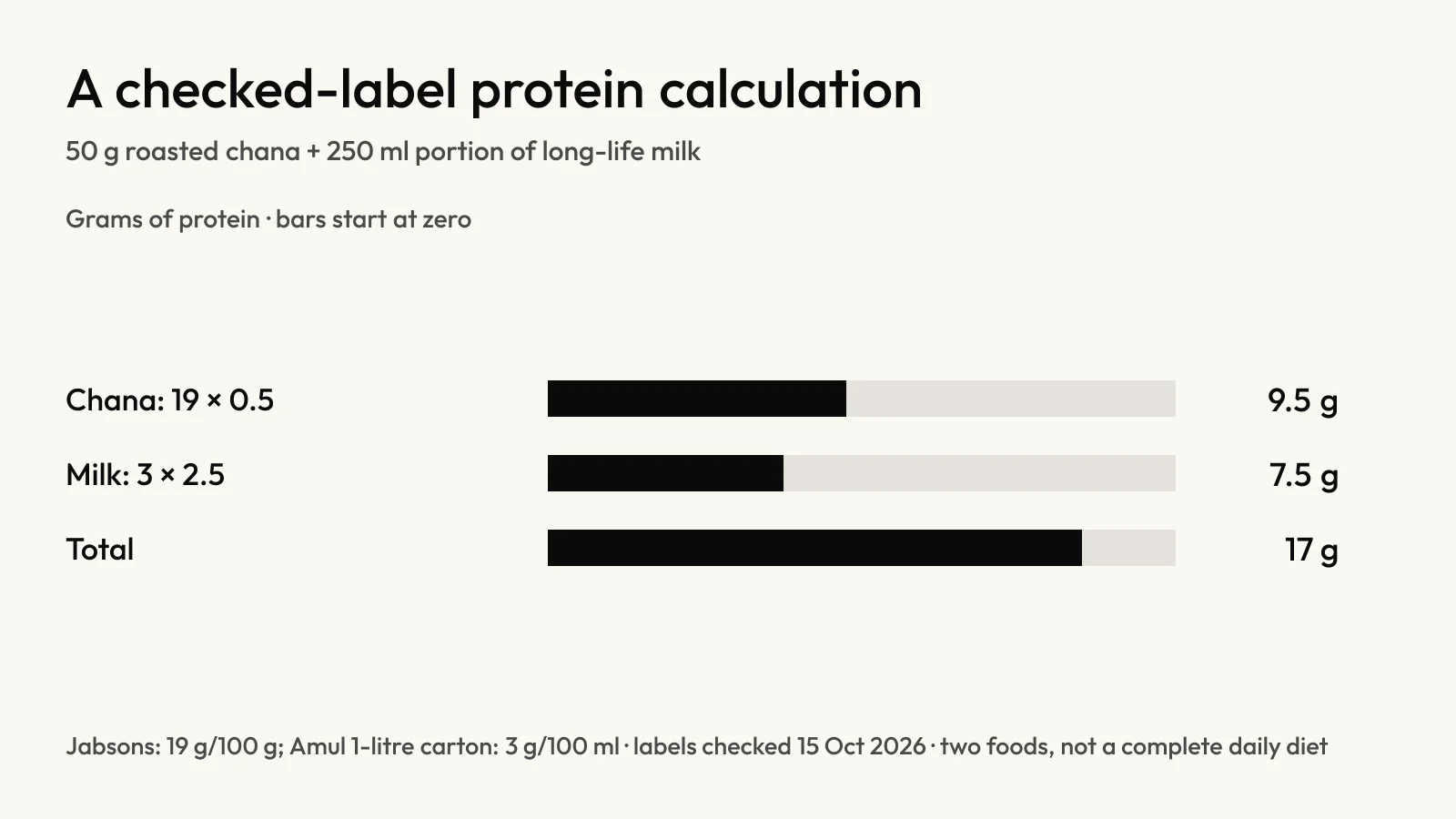
Using the two labels checked on 15 October 2026, 50 g of Jabsons White Salted Roasted Chana plus 250 ml of Amul Taaza Toned Milk gives a calculated 17 g protein and 355.5 kcal. Those figures describe these labelled products and portions.
Jabsons lists 19 g protein and 420 kcal per 100 g. Amul’s official nutrition image for its 1-litre long-life carton lists 3.0 g protein and 58.2 kcal per 100 ml. Jabsons product information, Amul product information
| Item | Specified portion | Protein calculation | Energy calculation |
|---|---|---|---|
| Jabsons roasted chana | 50 g | 19 × 50 ÷ 100 = 9.5 g | 420 × 50 ÷ 100 = 210 kcal |
| Amul Taaza milk | 250 ml | 3.0 × 250 ÷ 100 = 7.5 g | 58.2 × 250 ÷ 100 = 145.5 kcal |
| Total | Both portions | 17 g | 355.5 kcal |
Round the energy total to about 356 kcal when presenting the example. Manufacturers round label values, and another product may have different values.
The milk quantity is a 250 ml portion calculated from the verified 1-litre carton label. We have not verified a separate 250 ml pack with the same composition. If you pour this portion from a larger carton, arrange safe storage or consumption of the remainder.
This calculation covers two foods. It does not establish a complete meal, daily calorie target or universal protein requirement. The calorie-target guide addresses the separate question of setting a target.
What changes after you open a shelf-stable pack?
Follow the maker’s opened-pack instructions. Amul specifies ambient storage until opening, then refrigeration and use within two days. Without a suitable fridge, open a quantity you can consume at that sitting and discard the remainder.
Check storage again when you open the carton
- Before opening Check that the pack permits ambient storage and follow its label conditions.
- After opening The checked Amul carton requires refrigeration and use within two days.
You have a suitable fridge
Refrigerate after opening. Keep the fridge at or below 4°C and follow any stricter pack instructions.
You have no suitable fridge
Open only what you can consume at that sitting. Discard the remainder; choose a suitable pack size before buying.
Based on the linked Amul storage label and FDA guidance below. The verified carton holds 1 litre; the protein example uses a calculated 250 ml portion. Plan for the remainder before opening.
Do not keep an opened carton on the shelf for tomorrow. For foods requiring refrigeration, the FDA gives a maximum of two hours at room temperature, reduced to one hour above 90°F, about 32.2°C. It recommends a fridge at or below 4°C. Treat these as maximum limits and follow stricter product instructions. FDA food-storage guidance
Buy curd or paneer close to eating time if you cannot keep it chilled. Avoid saving mess leftovers in your room without appropriate storage. Smell and appearance cannot establish that a perishable food is safe.
The office-lunch storage example explains why transport and waiting time belong in the same food-safety plan. A sealed shelf-stable pack changes that plan only while it remains sealed and meets its label conditions.
How do you plan around the mess menu?
Start with the meals you can obtain from the mess, then choose a pantry addition for a specific gap in your timetable. Record what you ate before buying more food.
For example, keep a sandwich option for a morning when you cannot reach breakfast. Use roasted chana alongside a mess meal or as a separate eating occasion, according to your needs. Check meal times for weekends and holidays so you can buy suitable food before shops close.
For records, weigh packaged additions and mark uncertain mess portions as estimates. The homemade-meal logging method explains ingredient quantities and shared dishes.
What should you check before repeating these meals?
Check allergens, storage conditions and whether you can eat enough varied food across the day. Amul identifies milk as an allergen. Jabsons states that its chana may contain peanuts and tree nuts.
Seek advice from a doctor or registered dietitian before changing a prescribed diet. A dietitian can also help if food exclusions or hostel facilities make eating enough difficult. Review the supplement upper-limits guide before combining supplements; the food calculation does not assess those products. Find further meal-planning material in the nutrition topic.
Which sources support this answer?
The two-food calculation uses the manufacturers’ official nutrition images, checked on 15 October 2026. Product values and portions are specific; label rounding still applies. FDA guidance supports the perishable-storage limits. The pantry and assembly examples are editorial suggestions, without a claim that they form a complete daily diet. Source images are linked for verification; no third-party image loads on this page.
- Amul Taaza Toned Milk: official product information for the long-life carton, including nutrition and storage instructions.
- Amul’s official 1-litre carton nutrition image: 3.0 g protein and 58.2 kcal per 100 ml.
- Amul’s official long-life carton storage image: no refrigeration until opening; refrigerate after opening and use within two days.
- Jabsons White Salted Roasted Chana: official product information and label, 19 g protein and 420 kcal per 100 g, storage and allergen information.
- Jabsons’ official nutrition, ingredient, allergen and storage image for White Salted Roasted Chana.
- US Food and Drug Administration. Are You Storing Food Safely? Refrigerator and room-temperature limits for foods needing refrigeration.
Topic: Vegetarian meals. Assembling no-cook food alongside hostel mess meals, with product-label portion calculations and opened-pack storage checks.
Liftor is not a doctor and gives no medical advice.