Training
How many warm-up sets do you need before lifting?
The cited studies do not establish one warm-up set count for every lift. Use lighter practice sets before your working sets, chosen for the exercise and planned load. Liftor’s session planner can add one or two automatic rows using 50–70% of working load. Its beginner and no-history rules differ.
Updated: Added related reading on ordering cardio and weights, with preparation counted separately. Added related reading on set stopping decisions and completed repetitions.
What counts as a warm-up set?
A warm-up set lets you practise the exercise with less resistance before you do the sets written as training work. Keep a separate entry for it in your log.
If today’s session calls for three squat sets at 100 kg, a lighter squat set beforehand serves a different purpose from those three sets. You can rehearse your setup, check how the movement feels and approach the working load. Write the three prescribed sets under working sets, even if the warm-up adds more rows to the session.
A walk or a few unweighted movements can form part of a general warm-up. A lighter set of the lift itself gives you specific practice. Record which you did so that you can repeat a useful sequence next time, rather than treating all preparation as the same task.
This page gives a planning method for healthy adults who already know the exercise. If you have pain, an injury, a medical condition or restrictions on exercise, ask a doctor before using these examples. A lighter warm-up does not establish that you can train through pain.
Should the percentage use working weight or one-rep max?
Use the denominator that the programme or calculator names. A percentage of working weight gives a different result from the same percentage of one-rep max.
Suppose your planned working load is 100 kg and your estimated one-rep max is 125 kg. Sixty per cent of the working load gives 60 kg. Sixty per cent of the estimated maximum gives 75 kg. The difference is 15 kg, even though both instructions contain the same percentage.
| Reference number | Calculation | Result |
|---|---|---|
| 100 kg working load | 100 × 0.60 | 60 kg |
| 125 kg estimated maximum | 125 × 0.60 | 75 kg |
These are hypothetical inputs. They illustrate a unit check, rather than prescribing a load. The one-rep-max guide explains how an estimate differs from a tested maximum. You do not need a maximum attempt to multiply a known working load.
Name the reference weight before multiplying
Working-load reference
100 kg × 60%
60 kg
Liftor’s percentage rule uses the working target.
Estimated-maximum reference
125 kg × 60%
75 kg
This uses a different denominator.
Hypothetical inputs, with a 15 kg difference. This is a calculation check, without a recommended warm-up load or set count.
Write “per cent of working load” beside your own sequence. Include whether a dumbbell number means each hand or the pair. You can then check an old note without reconstructing what the weight meant.
How many warm-up sets should you choose?
Choose enough lighter sets to approach the planned lift with control, and keep the sequence easy enough to leave the working sets intact. The research does not establish one set count for each lifter and exercise.
In their 2015 review, McCrary and colleagues included 31 upper-body warm-up studies. They found support for performance benefits from high-load dynamic warm-ups, while the wide range of protocols limited pooled analysis. They found no studies of upper-body warm-ups with injury-prevention outcomes. The review supports warming up for performance. It gives no evidence that a fixed warm-up sequence prevents injuries. McCrary et al., 2015
For your own log, begin with the exercise you will do and the working load already prescribed. Note the lighter sets you tried, then record whether you needed another practice set before the work. Keep a useful repeatable sequence for that lift. A coach who can watch your technique can help if you cannot judge the setup or load.
You can find the rest of this training cluster in the training topic. Warm-up preparation and the decision to add weight across future sessions answer separate questions; use the progressive-overload guide for the latter.
What did the squat and bench-press study test?
Ribeiro and colleagues tested specific warm-up sequences before squat and bench-press training. They measured performance during that session, rather than long-term muscle growth or injury rates.
The 2020 study involved 40 resistance-trained men aged 19–30. They did three sets of six repetitions at 80% of maximum after different warm-ups: two six-repetition sets at 40% then 80% of training load, one set at 80% of training load, or one at 40%. The higher-load warm-up improved some squat velocity outcomes; the two-stage warm-up improved some bench-press outcomes compared with the lighter condition. The results differed by exercise. The authors concluded that a warm-up of few repetitions at low load was not enough to optimise squat and bench-press performance. Ribeiro et al., 2020
That study did not test Liftor’s 50–70% rule. It also did not establish an optimum for beginners, women, another exercise or a maximum attempt. Treat the app percentages below as its product rule, and the study as evidence that warm-up design and the lift both matter.
How does Liftor calculate its warm-up loads?
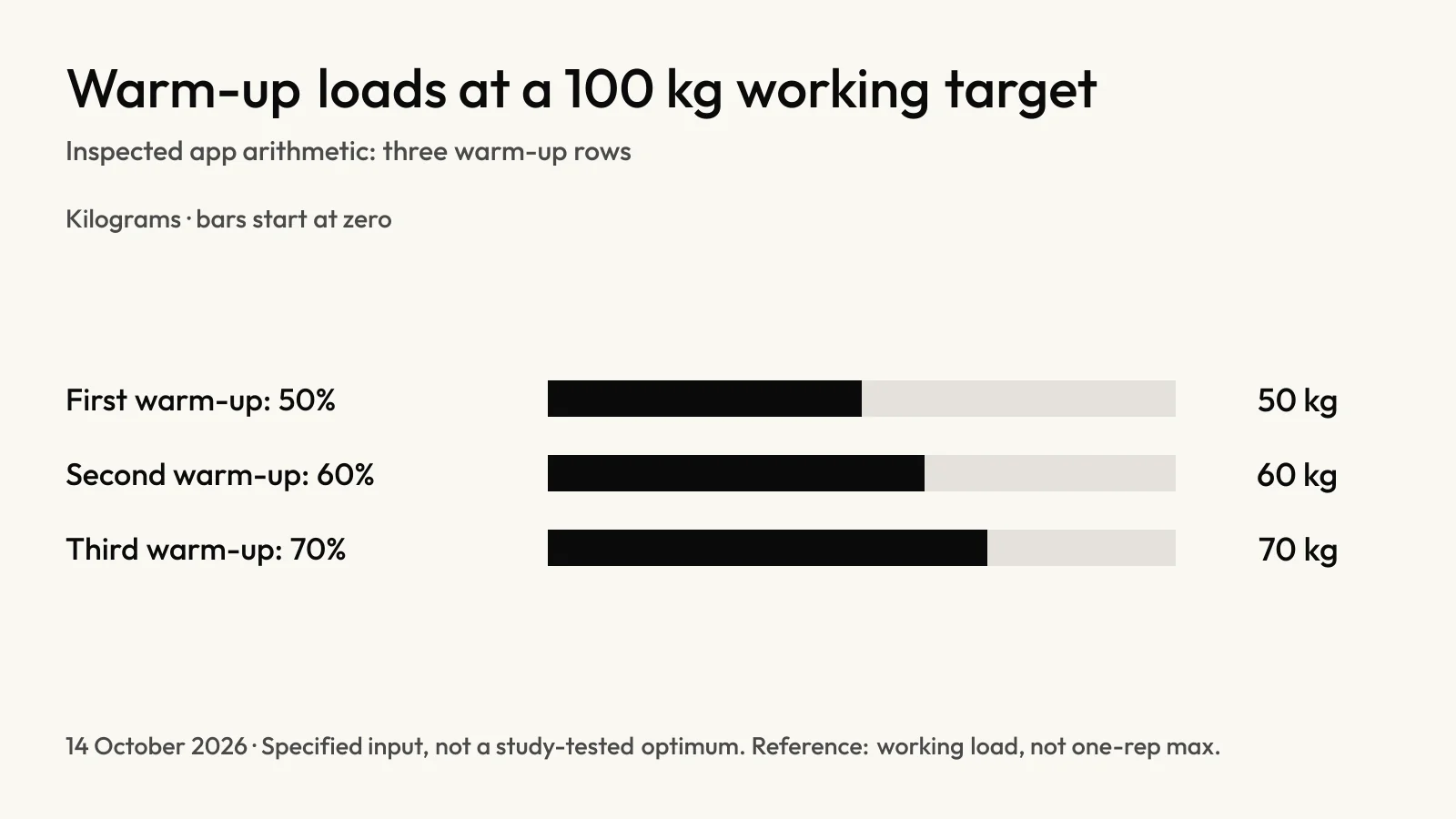
In Liftor 1.0.5, warm-up rows scale from the working target. One warm-up uses 60%; two use 50% and 70%; three use 50%, 60% and 70%. The planner adds at most two rows automatically, so the three-row case applies when you add a row yourself.
With a 100 kg working target on an ordinary loaded lift, that gives 60 kg for one row, 50 and 70 kg for two rows, and 50, 60 and 70 kg for three.
| Warm-up rows | Working-load percentages | Calculated loads at 100 kg |
|---|---|---|
| 1 | 60% | 60 kg |
| 2 | 50%, 70% | 50 kg, 70 kg |
| 3 | 50%, 60%, 70% | 50 kg, 60 kg, 70 kg |
The session code rounds tracked loads to the nearest 2.5 kg. Bodyweight, repetitions-only and unknown-load targets skip this percentage load rule. Assisted exercises use different arithmetic because a larger assistance number makes the exercise easier. Read the target and equipment convention before copying a number from another exercise.
The workout-session feature describes automatic warm-up sets. The source also keeps warm-up rows separate when numbering working sets and calculating working volume. Adding a warm-up therefore does not consume working set one.
Does Liftor add the same warm-up to every exercise?
Liftor’s session planner adds warm-ups under specific conditions. It uses exercise category, training level and whether the lift has a previous working load.
For a heavy compound with a known previous load, it plans 50% for five repetitions. It adds 70% for five for a lifter whose training level is not beginner. For a lighter compound with a known load, a non-beginner receives one 60% set of eight repetitions. The planner skips another automatic warm-up after it has warmed the same named muscle target.
With no history, a non-beginner’s heavy compound gets one eight-repetition warm-up row. The session screen then resolves its load from the working target if one exists. For a beginner without load history, it adds no automatic row. Cardio and the separate warm-up or cool-down blocks do not receive these extra rows.
These conditions explain the source behaviour; they do not tell you to skip preparation if a row does not appear. You can add a warm-up row in the session. Ask a coach for help choosing preparation if you are learning the movement, and check the displayed load before you log it.
What should you write in a repeatable warm-up log?
Write the exercise, working target and lighter rows, with the weight unit and any setup change. Keep the working results beneath them so that you can assess the complete session.
- Record the lift and planned working load, including each-hand or total-load conventions.
- List the warm-up weights and repetitions you performed.
- Mark those rows as warm-up, keeping the prescribed working-set count separate.
- Record the work completed and any reason you changed the plan.
Suppose you planned three work sets and inserted two warm-ups. Your log now has five rows, with three labelled working. If you only complete two working sets, keep that result visible. Counting all five rows as completed training work would hide the missed set.
Use the rest-between-sets guide for working-set recovery. If equipment availability changes the lift after you warm up, the reps-in-reserve guide explains how to describe effort under the replacement’s own name. After a break, the week-off-gym article covers what one trial found about a week without training.
Which sources support this answer?
The two papers below support the discussion of warm-up performance and its limits. Liftor’s approved feature description and the behaviour of Liftor 1.0.5 support the product rules; the worked examples show specified-input arithmetic.
- McCrary, Ackermann and Halaki (2015). A systematic review of the effects of upper body warm-up on performance and injury. British Journal of Sports Medicine, 49:935–942. Abstract read on PubMed; DOI resolved on 14 October 2026.
- Ribeiro et al. (2020). The Role of Specific Warm-up during Bench Press and Squat Exercises: A Novel Approach. International Journal of Environmental Research and Public Health, 17:6882. Abstract read on PubMed; DOI resolved on 14 October 2026.
- Liftor 1.0.5 for iPhone (on the App Store from 13 October 2026): warm-up percentages and row numbering, the planner’s eligibility, beginner and history rules, load rounding, and the displayed warm-up targets. Inspected and calculated read-only on 14 October 2026; summarised on the Features page.
Topic: Warming up. Specific practice sets before resistance training, with working-load calculations and their limits.
Liftor is free to download. Download for iPhone to create your plan.
Liftor is not a doctor and gives no medical advice.