Training
Do you need to train every set to failure to build muscle?
You do not need to take every set to muscular failure to build muscle. Research supports effective training that stops short, while closer-to-failure work can matter for growth. Keep effort high enough for your programme, record the repetitions you complete and choose a stopping point you can control.
What does muscular failure mean in this answer?
Muscular failure means reaching the point where you cannot complete another repetition through the prescribed movement. Studies also use other stopping rules, so read the definition before comparing results.
Stopping because your technique changes, reaching a target repetition count and being unable to complete another repetition are different events. Record the event that happened. A programme can ask you to stop with some repetitions in reserve; that is a deliberate stopping point even if you feel able to do more.
The RPE and reps-in-reserve guide explains how to describe effort. This page addresses whether every set needs failure, rather than providing another effort-scale table. Use your programme’s definition and a coach’s guidance if you cannot judge a stopping point while maintaining control.
What did the 2026 failure review find?
The 2026 review found no significant pooled difference in hypertrophy between failure and non-failure training. Its strength comparison favoured non-failure training; neither finding proves identical results for all stopping points.
Wu and colleagues included 20 studies with 556 participants. Non-failure training favoured dynamic strength with a standardised mean difference of 0.24 and a 95% confidence interval from 0.06 to 0.42. The researchers found no significant pooled differences in muscle growth, endurance, power or isometric strength. Wu et al., 2026
Non-failure covers the stopping rules the included trials used. It does not mean any set stopped at any effort produces the same growth. A pooled comparison also cannot guarantee your individual response or specify the best stopping point for a particular exercise.
Does stopping closer to failure still matter?
Closer-to-failure work can matter for muscle growth, even though taking every set to failure is unnecessary. The research does not establish one exact reserve target for all lifters.
Refalo and colleagues’ 2023 review included 15 studies. The comparison restricted to momentary muscular failure found no significant hypertrophy advantage, with an effect size of 0.12 and a 95% confidence interval from −0.13 to 0.37. Combining different definitions of set failure produced a trivial advantage of 0.19. The definition changes the comparison. Refalo et al., 2023
Robinson and colleagues’ 2024 exploratory meta-regressions associated training closer to failure with more hypertrophy, while strength gains showed a similar pattern across a wider range of estimated reserve values. The researchers estimated reserve from study descriptions, and the exact relationship remained uncertain. Robinson et al., 2024
Keep both conclusions: you can build muscle without reaching failure on every set, and stopping far from a demanding effort may change the stimulus. Choose the effort your programme prescribes instead of turning the first conclusion into permission to omit its effort target.
Which research comparisons answer different questions?
A failure-versus-non-failure comparison asks a different question from a reserve dose–response analysis. Keep the comparison beside its result before using it to choose a set target.
| Review | Comparison | Limit for your set target |
|---|---|---|
| Wu, 2026: 20 studies, 556 participants | Failure and non-failure protocols in healthy adults | A pooled result does not identify the best reserve for each exercise |
| Refalo, 2023: 15 studies | Different definitions of set failure, including momentary muscular failure | Definition matters; broad and momentary-failure results differ |
| Robinson, 2024 | Estimated reserve and adaptation across study descriptions | Exploratory association; exact growth optimum remains unclear |
Check whether a paper studies muscle size, a strength test or performance during a session. An easier recovery between today’s sets and a muscle-growth result over several weeks are separate claims. None of these three reviews tests the hypothetical 24-repetition prescription below.
How should you choose a stopping point?
Use the programme’s effort target, your ability to control the movement and the available setup. Choose the stopping point before the set where possible.
For a familiar exercise, note the repetition range and the reserve the coach asks you to keep. During the set, stop if you cannot maintain the prescribed movement or if pain or concerning symptoms appear. A target number does not require you to complete a repetition you cannot control.
If your programme includes a failure set, ask how it defines failure and how you should set up that exercise. A machine and a free-weight lift present different practical constraints. Do not arrange a failed repetition under a bar without knowing how to use the equipment’s appropriate safety setup.
This article covers healthy adults planning familiar resistance exercise. Ask a doctor first if a medical condition, recent injury or symptoms affect exercise, and use a qualified coach for unfamiliar lifts or stopping rules. This checklist is an editorial decision aid, without a claim that it validates a particular exercise for you.
What should you log if you complete fewer repetitions?
Log completed repetitions and the reason you stopped. Keep the planned target in a separate column so you can see what you performed.
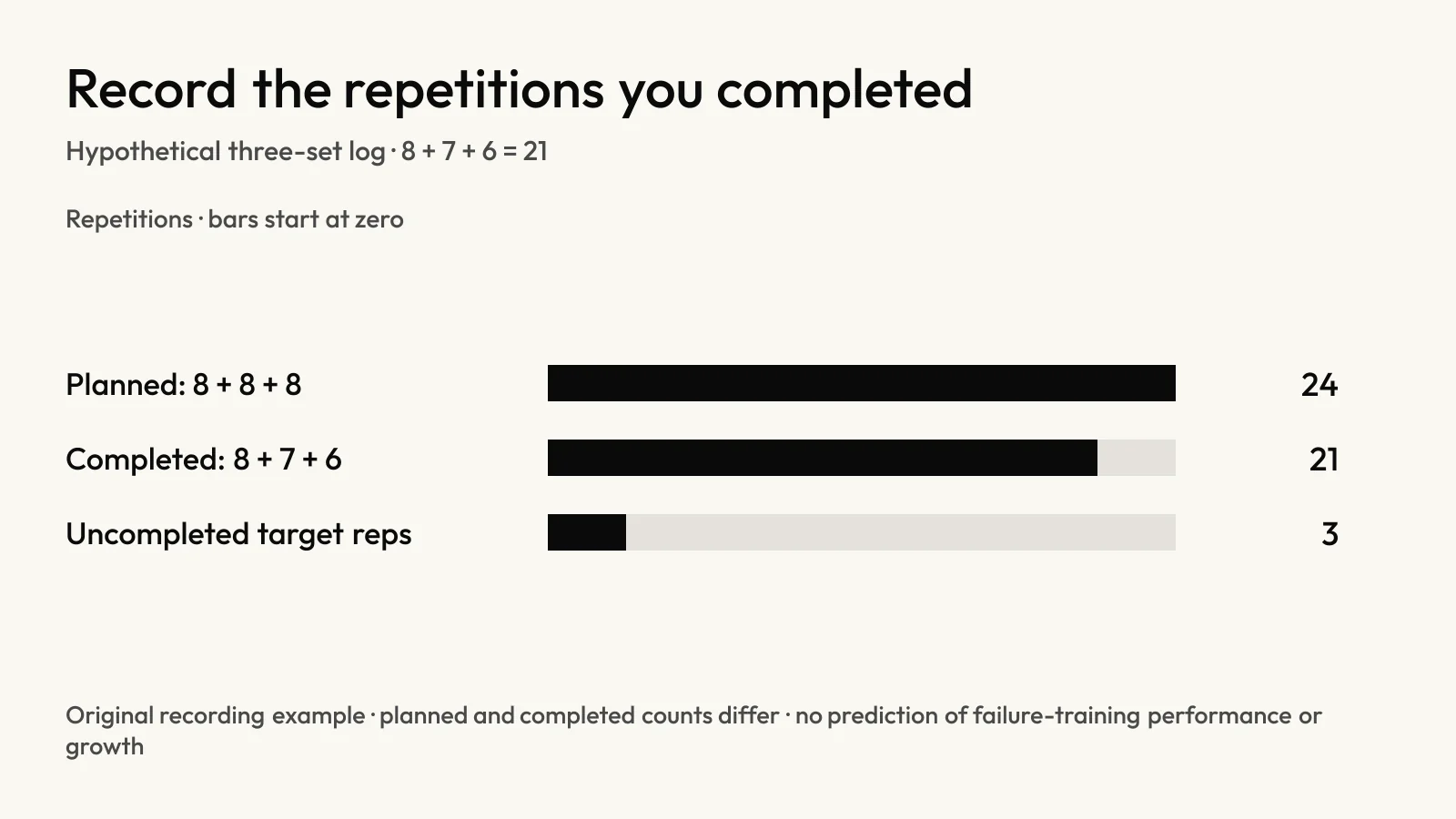
Consider an illustrative plan of three sets of eight. You complete eight, seven and six repetitions at the same recorded load. The plan contains 24 repetitions, while the result contains 21. The example assumes those results; it does not claim that training to failure causes that particular sequence.
| Set | Planned repetitions | Completed repetitions | Uncompleted target repetitions |
|---|---|---|---|
| 1 | 8 | 8 | 0 |
| 2 | 8 | 7 | 1 |
| 3 | 8 | 6 | 2 |
| Total | 24 | 21 | 3 |
Add the effort or stopping reason to each actual set. A count of 21 alone does not tell a coach whether you stopped at the prescribed reserve, lost control of the movement or ran out of time. Do not infer that you need three make-up repetitions from the final column. Review the programme and the circumstances before changing work.
Should you add weight after a failure set?
A failure set alone does not establish that you should increase load next time. Check the programme’s progression rule and the whole recorded result.
Keep the target range, performed repetitions and effort together. If the programme asks for several sets within a range, one top set does not describe whether you completed the other work. Use the progressive-overload guide for the progression method and its reserve gate rather than changing the rule after a single set.
For the 24-versus-21 example, a coach needs the exercise, load, set results and stopping reasons before choosing the next target. If you switched equipment, use the separate-exercise record method. Matching kilogram numbers on different equipment does not restore a like-for-like comparison.
Do soreness and exhaustion show that you trained hard enough?
Soreness and exhaustion cannot establish how much muscle you will gain. Judge the session against the work and effort you intended, then review results over time.
The soreness and muscle-growth article explains why soreness cannot serve as a growth measurement. Record symptoms as context instead of using them to increase the next set’s difficulty. Keep the completed-work record alongside that context.
Use the rest-between-sets guide when deciding how to recover between the planned sets. A difficult set does not remove the rest budget. For a shorter week, the twice-weekly training example explains how to account for sessions and weekly work. The training topic groups the related methods for building a record you can compare.
Which sources support this answer?
These reviews compare training protocols and summarise group outcomes. Their definitions of failure, participant experience and methods differ. Our 24-versus-21 repetition ledger is hypothetical, with no measured muscle-growth result. Abstracts read on PubMed and DOI destinations checked on 15 October 2026.
- Wu et al. (2026). Effects of resistance training performed to repetition non-failure on exercise performance in healthy adults: a systematic review and meta-analysis. BMC Sports Science, Medicine and Rehabilitation, 18:333. Twenty studies, 556 participants.
- Refalo et al. (2023). Influence of Resistance Training Proximity-to-Failure on Skeletal Muscle Hypertrophy: A Systematic Review with Meta-analysis. Sports Medicine, 53:649–665. Fifteen studies.
- Robinson et al. (2024). Exploring the Dose–Response Relationship Between Estimated Resistance Training Proximity to Failure, Strength Gain, and Muscle Hypertrophy: A Series of Meta-Regressions. Sports Medicine, 54:2209–2231.
Topic: Muscular failure. Interpreting failure and non-failure resistance-training research when choosing and recording a set’s stopping point.
Download for iPhone to record your training with Liftor.
Liftor is not a doctor and gives no medical advice.