Training
How do you choose exercise substitutions?
Choose an exercise substitution by preserving the purpose of the planned lift, then checking the movement, equipment and effort you can control. Start the replacement with its own load. Keep completed sets on the exercise you performed, and record remaining sets under the new exercise so the log stays accurate.
Updated: Added related reading on hotel dumbbell inventory and temporary session planning. Added related reading on journal comparisons when equipment changes.
What should an exercise substitution preserve?
Preserve the job the planned exercise does in the session. Name that job before choosing the alternative.
A bench press might supply horizontal pressing work, practice for the bench press itself, or both. A replacement can preserve some pressing work while giving you less practice with the original equipment and technique. Write which purpose you need today. This makes the trade-off visible instead of assuming that exercises sharing a muscle have identical effects.
For a temporary equipment problem, choose a familiar movement you can set up and control. If a coach wrote the programme, use their proposed alternative or ask them about the change. If your goal includes a specific lift, keep that lift in the longer plan when equipment access returns.
This method covers healthy adults adapting to unavailable equipment. It does not prescribe rehabilitation. If pain, an injury or a medical condition causes the proposed change, ask a doctor before using an exercise alternative. You cannot establish that a movement is suitable for an injury by matching its muscle group.
How can you check an alternative before using it?
Check the goal, movement and setup, then choose a load for the replacement. Use the checklist as a prompt for your decision rather than a score that proves equivalence.
- Name the planned exercise’s purpose: practising that lift, training a movement, or adding work for a muscle.
- Choose a familiar alternative that serves the purpose with your available equipment.
- Check the setup, range you can control and loading convention.
- Choose the replacement’s own load and assess the effort against the prescribed repetition range.
- Record the change and its reason under the correct exercise name.
A replacement that needs a bench will not solve a queue for all the benches. A movement you have never learnt may also cost more time than waiting for familiar equipment. Check the whole setup before you leave the original station.
You can keep a short alternative beside a frequent exercise in your training notes. Record the equipment it requires so the note remains useful in another gym. The training topic groups these practical planning methods with the guides.
Which familiar alternatives can you consider?
Use movement categories to make a shortlist, then check the specific exercise against your goal. The examples below are planning options for someone who already knows them, rather than instructions to learn a new lift during a queue.
| Planned work | Possible familiar option | Detail to check |
|---|---|---|
| Horizontal press | Dumbbell press in place of barbell press | Bench access; load per hand; different setup |
| Horizontal pull | Supported dumbbell row in place of seated row | Support and space; each-side repetitions |
| Vertical pull | Pulldown in place of pull-ups | Machine availability; separate load history |
| Knee-dominant leg work | A familiar squat variation | Available resistance; technique; original lift practice |
| Hip hinge | Dumbbell Romanian deadlift in place of barbell Romanian deadlift | Grip; load per hand; separate load history |
| Vertical press | Seated dumbbell press in place of standing barbell press | Back support; load per hand; different setup |
These rows show a way to compare options. They do not assign equal kilogram loads or claim identical muscle growth. Keep the detail that changes beside the choice, if you move from a bilateral exercise to one performed a side at a time.
If you lack an appropriate familiar alternative, keep the incomplete work visible and revisit the programme. A log can record a shorter session. You do not need to invent a replacement to make its set count look complete.
Will swapping exercises preserve your progress?
A planned alternative can help you complete training, but the research cannot guarantee identical progress from an individual swap. Exercise choice matters most when you want to improve a specific movement.
Kassiano and colleagues’ 2022 systematic review included eight studies and 241 young men. They found that systematic exercise variation could affect muscle growth and strength, while excessive random variation could hinder adaptations. The review supports making changes for a reason, without proving that a particular pair of exercises is interchangeable. Kassiano et al., 2022
Haugen and colleagues’ 2023 review included 13 studies comparing free weights with machines, five of which measured muscle growth. That hypertrophy analysis found no detected difference, with a standardised mean difference of −0.055 and a 95% confidence interval from −0.397 to 0.287. Strength changes depended on the equipment used in testing. Those group findings do not supply a load-conversion formula for two exercises. Haugen et al., 2023
If you swap for one busy session, keep its reason in the log. If the same equipment problem recurs, choose a stable alternative with your coach and track that exercise across sessions. Use the progressive-overload method to assess its own repetitions and loads.
Can you carry the old kilogram target into the replacement?
Choose a load for the new exercise from its own setup and history. Matching movement categories does not give you a kilogram exchange rate.
A barbell figure may describe total load. A dumbbell entry may describe each hand. A machine stack displays the selected resistance for that machine. Write the convention in your log before comparing sessions. Two numbers can share the unit kg while describing different equipment and tasks.
Suppose your old exercise entry says 60 kg for eight repetitions. The replacement still needs its own first-set target. Begin with a load you can control in the prescribed range, check your effort and record what you do. The RPE and reps-in-reserve guide explains the effort terms your programme may use.
Keep a separate history under the replacement’s name. If you return to the original movement next week, compare its result with its own previous sets. A larger displayed number on different equipment does not establish a personal record for the old lift.
What happens if you swap after logging a set?
Keep completed work on the exercise you performed, then put the remaining work under the replacement. This preserves the session record without claiming that a completed set happened on different equipment.
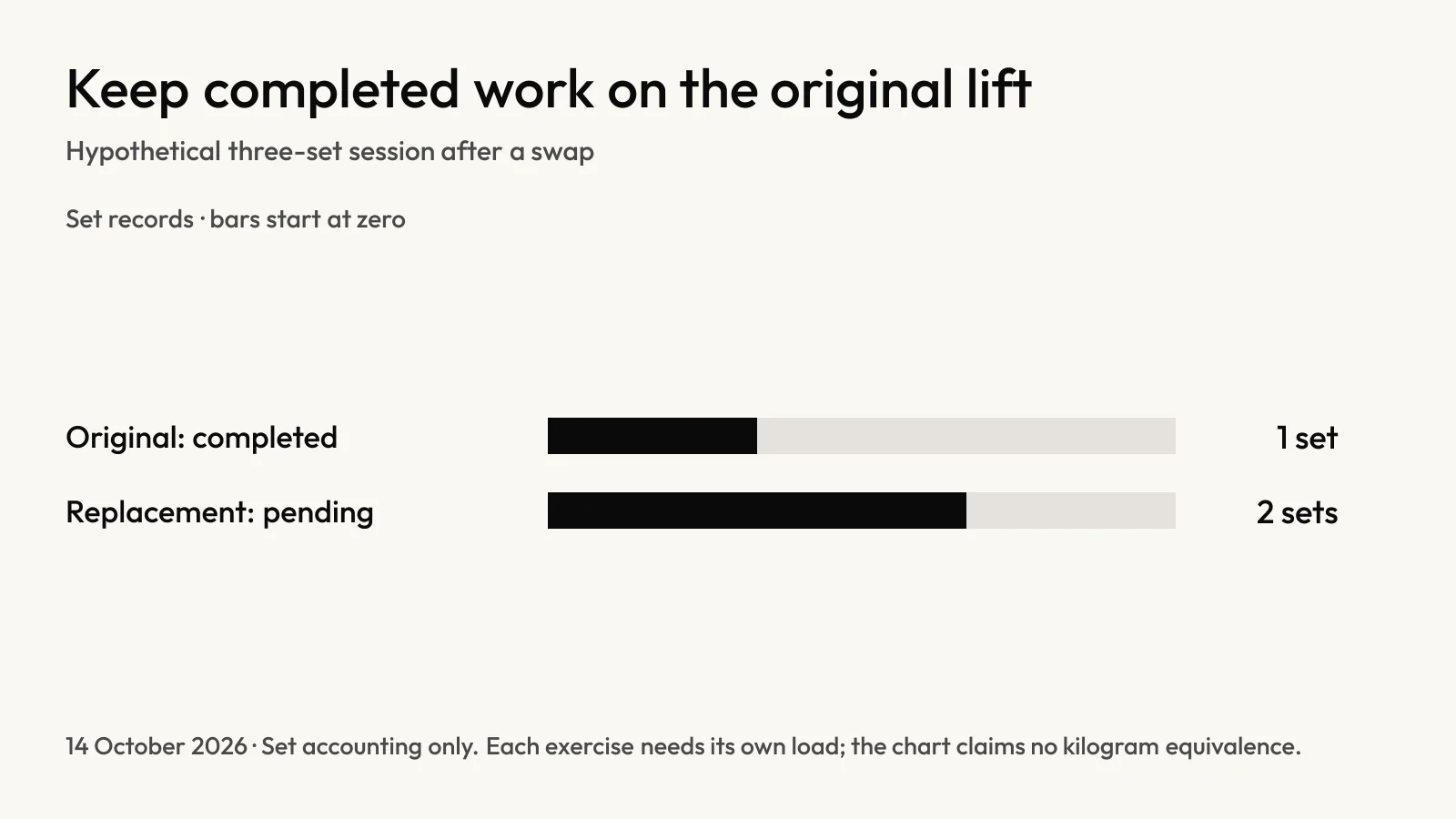
Consider a hypothetical session with three planned barbell bench-press sets. You complete one, then swap because you lose access to the station. The ledger should show one completed original set and two remaining replacement sets.
| Record | Completed sets | Sets still to do |
|---|---|---|
| Original bench press | 1 | 0 on this card |
| Replacement press | 0 | 2 |
| Session ledger | 1 | 2 |
The count remains one completed and two pending. It does not mean that the replacement supplies identical training or that its two sets deserve the old load. Record its working load after checking that exercise.
We tested this example against Liftor 1.0.5. It kept a logged 60 kg × eight-repetition bench set on the original exercise and added a new card for the pending work. The new card started with no prefilled load, no completed repetitions and no previous-set history.
Leave the performed set under its original name
Original bench-press record
Set 1
Done
Logged: 60 kg × 8 repetitions.
Pending on this record: 0 sets.
Replacement-press record
Set 1
Pending
Set 2
Pending
Choose this exercise’s own load.
No prefilled load, completed repetitions or inherited previous-set history.
Hypothetical example, checked against Liftor 1.0.5 on 14 October 2026. One completed set and two pending sets remain in the session. This is a record diagram, without a kilogram conversion or app-interface depiction.
How does Liftor handle a mid-workout exercise swap?
Liftor’s trainer can offer replacement choices during a workout. In Liftor 1.0.5, the session changes only after you choose an option.
The trainer offers up to four replacements, with a choice to keep the current exercise. Choosing a replacement keeps your logged sets on the original exercise and starts the replacement without the old exercise’s load history. A suggestion alone does not apply the swap.
The manual exercise-selection flow also asks which scope should receive the change. Read that scope before confirming if you want a temporary session change rather than a wider plan edit. A replacement you choose through the trainer changes the current session only; it does not rewrite the rest of your week.
The mid-workout trainer feature describes this proposal method. You can use the same recording discipline in a notebook: leave old results under the old name, choose the new target and write the reason for changing it.
What should you check before the next session?
Check whether the original equipment problem has ended and which exercise the next session prescribes. Keep the temporary replacement’s history available without overwriting the original lift.
If you return to the original exercise, use its own previous log and prepare for that movement. The warm-up-set method explains why the reference load belongs to the lift you will perform. Use the rest guide when selecting recovery between the new working sets.
For a longer gym closure, make the equipment decision before the week begins. The temporary home-session example shows how to keep that change alongside your return plan. A repeated restriction needs a programme you can carry out with the equipment you have.
Which sources support this answer?
The reviews below support the discussion of exercise variation and training specificity. The substitution checklist is an editorial planning method, not a validated scoring system. Liftor’s approved trainer description and the behaviour of Liftor 1.0.5 support the product example.
- Kassiano et al. (2022). Does Varying Resistance Exercises Promote Superior Muscle Hypertrophy and Strength Gains? A Systematic Review. Journal of Strength and Conditioning Research, 36:1753–1762. Eight studies, 241 young men. Abstract read on PubMed; DOI resolved on 14 October 2026.
- Haugen et al. (2023). Effect of free-weight vs. machine-based strength training on maximal strength, hypertrophy and jump performance: a systematic review and meta-analysis. BMC Sports Science, Medicine and Rehabilitation, 15:103. Abstract read on PubMed; DOI resolved on 14 October 2026.
- Liftor 1.0.5 for iPhone (on the App Store from 13 October 2026): the mid-workout trainer’s replacement options and confirmation, the swap scope, and how a replacement keeps logged sets and starts a new exercise record. Inspected, and the swap example tested, read-only on 14 October 2026; summarised on the Features page.
Topic: Strength training. Selecting temporary exercise alternatives when equipment is unavailable, with separate load records and completed-set accounting.
Liftor is free to download. Download for iPhone to create your plan.
Liftor is not a doctor and gives no medical advice.