Strength
What should you write in a workout journal?
Write the exercise, load, repetitions and effort for each working set, plus the date and a short note about anything that changed the session. Keep your recorded results separate from your explanation. At your next review, compare the same exercise under similar conditions and choose one action you can check.
What belongs in the set record?
Record enough detail to recognise the exercise and compare the work at your next session. Start with the date, movement name and variation, then write the load and repetitions for each working set.
Include the load unit. “40” leaves kilograms, pounds and a machine-stack setting open to interpretation. For dumbbells, state whether the load refers to one hand or the pair. Record an exercise’s place in the session if you intend to compare it with a previous visit.
Write the results you completed beside the prescription. “3 × 10” could mean three planned sets of ten or thirty completed repetitions. A record such as “10, 9, 8 at 40 kg” names the completed work and preserves the difference between sets. The strength topic hub links to concepts you may want to review alongside the record.
Should you record warm-up sets and replacements?
Keep warm-up sets identifiable, and name a replacement as a separate movement. You can then see which numbers describe preparation and which describe the planned working sets.
Label preparation sets as warm-ups so you can distinguish them from working sets during review. The warm-up sets article explains the distinction and the limits of percentage-based examples.
For a replacement, write the exercise you used and its load. A completed bench-press set remains a bench-press record if you finish with another pressing movement. Follow the exercise-substitution method to separate old work from remaining sets. Loads on different movements or machines do not provide a direct comparison.
How should you record effort?
Use one effort measure you understand and label it. Reps in reserve, or RIR, describes how many more repetitions you estimate you could have completed before reaching failure.
A set of ten with an estimated three repetitions left differs from a set of ten with none left. The repetition count alone leaves that detail out. You can write “RIR 3” beside the set, using the RPE and RIR guide if you need the definitions.
Treat the estimate as your report. You may be uncertain about it while learning the exercise. Write “RIR uncertain” instead of supplying a number to complete the form. Use consistent effort labels.
What can you learn from two comparable sessions?
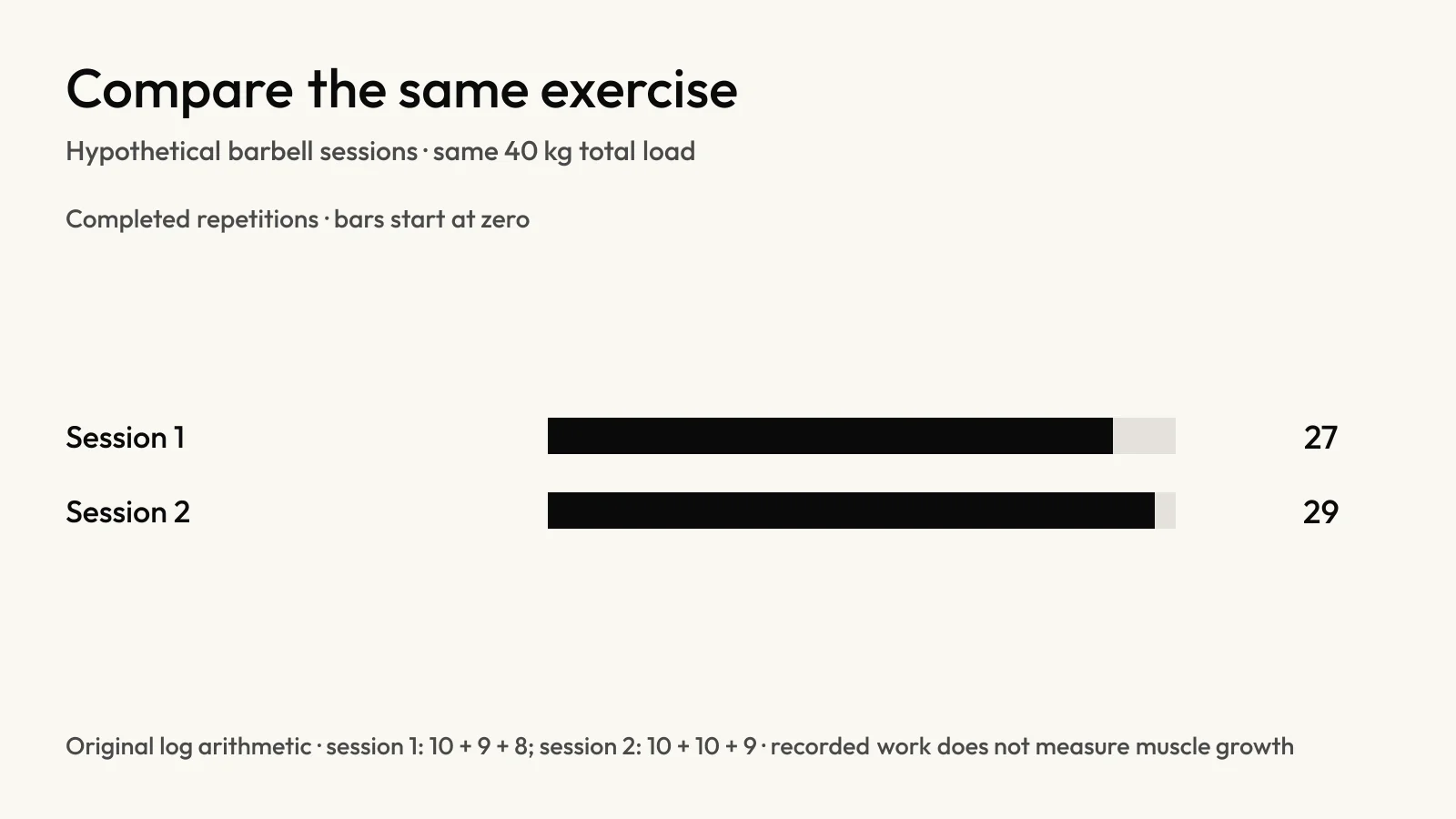
Compare completed repetitions, load and reported effort, while preserving anything that made the sessions different. Two entries can show a change in recorded work; they cannot establish a long-term trend or measure muscle growth.
The following record is hypothetical. Both visits use the same barbell bench-press variation, a total barbell load of 40 kg, an 8–10-repetition prescription, two-minute rests between working sets and the exercise first in the session.
| Field | Session 1 | Session 2 |
|---|---|---|
| Working-set repetitions | 10, 9, 8 | 10, 10, 9 |
| Total repetitions | 27 | 29 |
| Total barbell load | 40 kg | 40 kg |
| Estimated RIR, in set order | 3, 2, 1 | 3, 2, 1 |
| Rest between working sets | 2 minutes | 2 minutes |
| Load × completed repetitions | 1,080 kg | 1,160 kg |
| Context | Usual setup | Same setup; no station wait |
The second entry contains two more repetitions and 80 kg more load-times-repetitions. That arithmetic describes this record. It does not mean strength or muscle size increased by a matching percentage. Use the progressive-overload guide to decide how completed work relates to the next prescription.
What changes if the third session uses dumbbells?
Start a separate exercise comparison. A larger load-times-repetitions total on another movement does not prove that you improved the original lift.
Suppose a third hypothetical visit uses a dumbbell press with 20 kg per hand for 10, 10 and 10 repetitions. The combined load is 40 kg, so its arithmetic total is 40 × 30 = 1,200 kg. That exceeds the previous barbell total of 1,160 kg by 40 kg, but describes different equipment and a different task.
Name the dumbbell variation, record the per-hand convention and keep its setup in the note. Compare a later dumbbell visit with this record. Keep the original barbell sessions together instead of naming the third visit a barbell personal record.
What belongs in a context note?
Write a short observation that could affect how you interpret or plan the next session. Name what happened, including the amount or duration when you know it.
A useful note might say, “Waited seven minutes for the bench; omitted the final accessory movement to leave at 07:30.” That tells you about the appointment and the equipment. “Bad session” gives you less to work with.
You can also record a coaching cue you want to practise or a preference you want to discuss. Keep those notes separate from the set numbers so you do not confuse a requested change with work you completed. Use soreness as a description of how you felt, with the limits in the soreness-and-muscle-growth article. A soreness note cannot tell you how much muscle you gained.
How do you separate a fact from an interpretation?
Label the observation, possible explanation and next action as separate fields. You can then revise the explanation without changing the recorded event.
| Field | Hypothetical note |
|---|---|
| Observed fact | I waited seven minutes for the bench and omitted one movement to leave at 07:30. |
| Interpretation to check | The usual exercise order may not fit this morning’s slot. |
| Next action | Check the station before warming up, budget for a wait and decide which work to defer. |
| Review | After the next comparable morning visit. |
The seven-minute wait supports a scheduling question. It cannot establish that you recovered poorly or need a different training goal. Keep the original set record intact during this review. Add a correction if you notice a recording error, and name the correction so a later comparison does not rely on the old number.
When should you review the journal?
Choose a review date or the next comparable session, then read the previous entry before starting. Check whether your intended action addresses the observation you recorded.
For the hypothetical bench example, review the setup, load, repetition prescription and effort target. After the session, record what you did before judging whether the change helped. A lower repetition count after another exercise is a different comparison from repeating the bench first.
Use a short review note: “Kept the bench first; completed 10, 10, 9; same rest; still uncertain about final-set RIR.” You preserve both the numbers and their limits. Revise the next action when the observation changes instead of repeating a note whose circumstances no longer apply.
Where do personal training notes go in Liftor?
Liftor’s Nervous System screen has an Add note control for your own title and text. Use that space for a preference, an observation or a question you want to retain as context.
For example, title the hypothetical note “Morning gym appointment” and write the station wait, the finish time and the action you plan to check. Keep the set table in your workout record or notebook. Adding this note does not turn its prose into a set log.
Liftor’s features page describes the map and its notes. The coach retrieves a bounded selection of relevant context for answers; adding a note does not guarantee that each answer will use it. The feature also does not establish your explanation as a scientific finding or replace a qualified coach’s advice.
How do you revise a note in Liftor?
Open your own note from the map to edit its title or text, or archive it when the situation no longer applies. Keep dates in the wording if they help distinguish an old observation from a current preference.
A note such as “I have thirty minutes on Mondays” needs revision after your schedule changes. Replace it with the new constraint or archive the old note, then check what you have written. Edit your own material; the app’s controls distinguish user-authored notes from inferred observations.
Liftor lets you flag an eligible inferred or measurement node as wrong. That is a different control from editing your own note. Read Liftor’s Privacy Policy before adding sensitive information, and include the details you need for the question you intend to ask.
How much detail is enough?
Keep enough detail to identify the exercise, compare its sets and understand a relevant change. You can leave the rest out.
A set record and one dated observation may cover a routine session. Add detail when you have a question to resolve, such as an equipment change or a recurring time limit. Avoid treating the journal as a requirement to score your day or explain each variation in performance.
This method offers general planning information for adults. Seek a clinician’s advice before changing exercise if you have medical conditions or concerns, or have not exercised for some time, as the NHS adult activity guidance advises. A journal cannot assess those concerns.
Which sources support this answer?
The journal, session comparison and review note are hypothetical editorial examples. Liftor’s approved Features page and app source supply the note controls and bounded coach-context behaviour. The RPE and RIR guide supplies effort definitions; NHS guidance supports the exercise precaution. Sources inspected on 15 October 2026. Adding a prose note does not turn it into a structured set log or guarantee that a plan uses it.
- Liftor Features: the living map and notes. Checked against the iPhone app’s Nervous System screen, own-note controls, context selection and coach-prompt path on 15 October 2026.
- Liftor’s RPE and RIR guide: definitions and limits of reported effort.
- NHS. Physical activity guidelines for adults aged 19 to 64: advice for adults with medical conditions or concerns, or who have not exercised for some time.
Topic: Training diary. Recording completed sets and dated context while keeping observations separate from interpretations and equipment comparisons.
Add a note you can check at your next review. Download for iPhone.
Liftor is not a doctor and gives no medical advice.