Recovery
Is soreness a sign of muscle growth?
No. Soreness cannot tell you how much muscle you have grown. Researchers have recorded muscle growth with little reported soreness. Compare your training sessions and keep soreness in a separate note. A training log records performance; measuring muscle growth requires a different assessment. Get medical advice for pain that worries you.
Updated: Added related reading on failure decisions and comparable workout-journal records.
What does soreness after a workout tell you?
Soreness tells you how your muscles feel after training. You cannot convert that feeling into a measurement of muscle growth.
Delayed onset muscle soreness, or DOMS, is muscle pain that develops after exercise. Cleveland Clinic’s DOMS guidance, reviewed in December 2025, describes an onset one to three days after a workout. That timing describes the experience; it does not provide a muscle-growth score.
In Brad Schoenfeld’s 2012 review, the author discusses damage after unfamiliar exercise and the role of eccentric contractions, where a muscle lengthens under tension. He also describes disagreement over the proposal that muscle damage must precede growth. The review’s abstract supplies no equation linking soreness to added muscle.
Write down what changed before deciding that a sore session worked better. You might have used another exercise, added sets or changed the movement range. Those changes deserve their own notes. You can find related training questions in the Recovery topic hub.
Can muscles grow without soreness?
Yes. Participants gained muscle size after a gradual ramp-up that avoided detectable soreness in a small trial.
Flann and colleagues’ 2011 study included 14 university students, seven in each group. One group completed a three-week ramp-up before eight weeks of eccentric cycling; the other entered the eight-week programme without that ramp-up. The programme was designed to equate the total work done by the two groups.
Quadriceps muscle volume grew by 6.5% and 7.5%. The researchers found no statistically significant between-group difference (P = 0.576). Strength rose by about 25% and 26%.
The group that skipped the ramp-up showed the signs of damage. Its members reported more soreness at the start, and their creatine kinase, a blood marker of muscle damage, was more than five times higher. Their gains in muscle size and strength did not differ from those of the ramp-up group.
The specialised cycling protocol and small sample limit the finding. The researchers could not exclude undetected microscopic damage. This experiment does not predict your growth or establish an ideal gym programme.
You do not need to reproduce that training protocol.
What should you record instead of using soreness as a score?
Record the work you completed under comparable conditions. Record soreness beside that work, with its own description.
For each exercise, note the equipment and load, then write the repetitions for each working set. Add your estimate of repetitions in reserve, or how many further repetitions you think you could have completed. Use the same terms across your records. Warm-up sets belong in a separate part of the log.
Keep the movement range and rest between sets explicit. Eight repetitions on one machine do not make a matched comparison with eight on another. The rest-between-sets guide covers that variable; your log should say which rest period you used.
This record lets you check whether you followed the prescription and compare performance across sessions. It does not measure muscle thickness or muscle volume. A stronger set, a larger repetition count and a less sore morning each describe a different observation. You need no conversion between them to keep a useful record.
What does a useful three-session log look like?
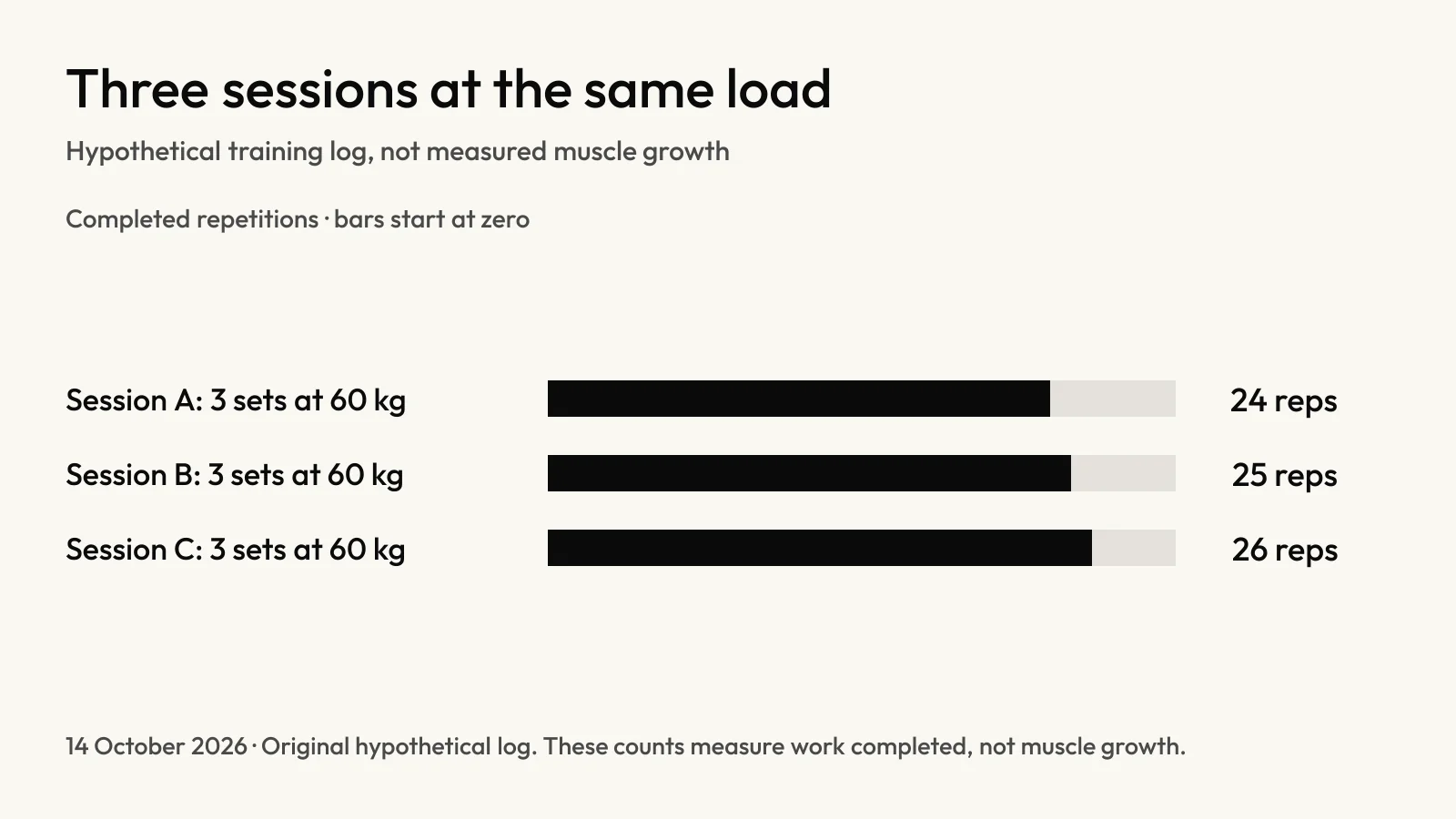
A useful log keeps the exercise and conditions clear while showing the repetitions you completed. The following numbers are a hypothetical worked example, created on 14 October 2026, rather than a dataset from study participants or Liftor users.
Assume the same familiar exercise, equipment and movement range in all three sessions. The lifter uses 60 kg, three working sets, the same rest period and an estimated two repetitions in reserve per set. The load is an example, not a recommendation for you.
| Session | Repetitions at 60 kg | Total repetitions | Soreness note at the next check-in |
|---|---|---|---|
| A | 8, 8, 8 | 24 | More noticeable |
| B | 8, 8, 9 | 25 | Less noticeable |
| C | 9, 8, 9 | 26 | None reported |
The calculation is 8 + 8 + 8 = 24 repetitions in session A and 9 + 8 + 9 = 26 in session C. The example lifter completed two more repetitions across the same three sets. The soreness notes decreased.
Those are the two conclusions the records support. The table contains no measurement of muscle growth, and the entries cannot prove that less soreness caused the added repetitions. Follow your existing progressive-overload method to decide how completed work affects the next prescription.
How can you decide what to do at the next session?
Use your plan, the work you can perform with control and any concerns about pain. The following steps are an editorial planning method for adults familiar with their exercises; they are not a clinical test or a rehabilitation protocol.
- Read the planned session. Check the exercises, sets and target effort before warming up. Keep the intended task clear.
- Record the starting context. Note soreness in your own words and any change in equipment or schedule. The readiness-score guide explains broader morning inputs.
- Check familiar movement. Do not force a repetition through pain or change your technique to finish the written count. Stop and seek appropriate advice if you are concerned.
- Record what you chose. Write down any reduced work, changed movement or postponed session. At the next review, compare like with like.
For example, a session with two completed sets differs from one with three, even if both contain eight repetitions per set. Write the missing set down. Do not label the difference as muscle loss or assume that an extra set would have fixed it.
A planned lighter week belongs in the deload guide. A complete interruption raises separate questions, which the week-off-the-gym article addresses. Keep the reason for each choice in the record.
Should you change exercises to make yourself sore?
You do not need to chase soreness to judge whether you completed the intended training. Choose an exercise change for a stated purpose, such as the equipment you have or the movement you can perform with control.
Write that purpose beside the new exercise. Compare later sessions with the same movement before drawing conclusions about its performance. You cannot carry an old machine’s load straight into a new machine's record and call the number an improvement.
During a busy week, you might need to change the venue rather than the goal. The gym-closure planning article gives an example of recording that constraint. Keep changes deliberate and traceable, so you can explain what you trained when you return to your usual equipment.
How should you review several weeks of records?
Read matched sessions together and separate observations from explanations. A short weekly review can start with two questions: did you complete the intended work, and did you record the conditions well enough to compare it?
Mark a change in load or exercise before adding up repetitions. Review one movement at a time. Then read the soreness notes without assigning a growth percentage to them. A blank soreness entry means you did not record an observation; it does not mean that you felt none.
If a session went worse than planned, write the result before guessing why. You may know that you used different equipment; you may have no explanation. Keep that distinction in your notes. You can discuss the records with a qualified trainer instead of rebuilding the programme from one sore morning.
When should you seek medical advice?
Seek advice for pain that concerns you. Cleveland Clinic advises medical review for sharp, constant pain, severe swelling, pain lasting more than a week, or unusually dark urine or blood in urine. These signs do not belong in a workout scoring system.
The NHS advises speaking to a doctor before exercise if you have medical conditions or concerns, or have not exercised for some time. Ask a clinician about unexplained pain rather than using this article to identify its cause.
Which sources support this answer?
Published research supplies the limited growth finding and exercise context. Clinical guidance supplies the point at which to ask for advice.
- Flann et al. (2011). Muscle damage and muscle remodeling: no pain, no gain? PubMed PMID 21270317.
- Schoenfeld (2012). Does exercise-induced muscle damage play a role in skeletal muscle hypertrophy? PubMed PMID 22344059.
- Cleveland Clinic (reviewed 19 December 2025). Delayed Onset Muscle Soreness (DOMS).
- NHS (reviewed 22 May 2024). Physical activity guidelines for adults aged 19 to 64.
Topic: Delayed onset muscle soreness. Soreness after resistance training, its limits as a growth indicator, and comparing training records.
Liftor is not a doctor and gives no medical advice.