Real life
How do you plan a hotel gym dumbbell workout?
Check the hotel’s dumbbell pairs, usable space and bench before choosing the session. Pick familiar movements that fit the equipment, then count preparation, sets, rests and transitions against your available time. Keep each dumbbell’s load clear in the log. A temporary travel session need not reproduce your usual gym programme.
What should you check before choosing exercises?
Check which complete dumbbell pairs you can use, whether a bench is suitable and where you have clear space. Write the equipment you found before adapting the planned session.
A hotel description saying “fitness centre” does not specify the weights or equipment in that room. Ask about opening hours and access before setting an appointment. On arrival, check the actual inventory rather than assuming it matches a photograph.
| Observation | Decision to check |
|---|---|
| Pairs in the loads you normally use | Which familiar movements fit the session? |
| Only lighter pairs | Can your familiar programme adapt to these loads? |
| No suitable bench | Do you already know an appropriate standing or floor-based option? |
| Labels in pounds | Record lb and the per-hand convention |
| Missing pair or damaged equipment | Choose other suitable equipment or leave that work out |
Do not improvise a bench from a luggage rack or use damaged equipment to complete a prescribed movement. A missing setup can justify a smaller session. The real-life topic collects other examples of fitting training around temporary constraints.
Which movements can you include without a bench?
Choose standing or floor-based movements you already know, and check the setup for each one. A list of possible movements does not establish that you should perform all of them.
For someone familiar with them, a goblet squat, dumbbell Romanian deadlift, standing press or dumbbell floor press may offer options without a bench. A row also needs an appropriate position and support arrangement; a supported variation from your usual gym may not fit this room.
Choose from your programme and your coach’s alternatives. Match the purpose of the work before changing the equipment, using the exercise-substitution method. This article is a planning method, rather than instructions for learning those movements during a short visit.
This example covers healthy adults doing familiar exercise. Ask a doctor first if a medical condition, injury or symptoms affect exercise. Ask a qualified coach about an unfamiliar movement or setup; the hotel room’s available equipment cannot determine its suitability for you.
Can lighter hotel dumbbells be useful?
Lighter dumbbells can support resistance work, but they may not serve the same goal as the heavier equipment in your usual programme. Check both effort and the specific task you want to practise.
The 2026 ACSM position stand synthesised 137 systematic reviews covering more than 30,000 participants. Equipment type did not consistently affect outcomes across the reviewed programmes, while heavier loads, at least 80% of one-rep max, enhanced maximal strength. Those findings concern programmes in healthy adults, with trials lasting six to 52 weeks. Currier et al., 2026
The review does not show that a light hotel session reproduces heavy barbell practice. If the dumbbells cannot produce the intended effort within your planned repetition range, record the constraint and ask your coach how to adapt. Avoid inventing an extreme repetition target to make the equipment appear adequate.
Use the effort guide to describe the set you performed. Treat the load ceiling as a fact about this room, without turning it into a claim about the training results you will get from a short trip.
What could fit into a 30-minute hotel session?
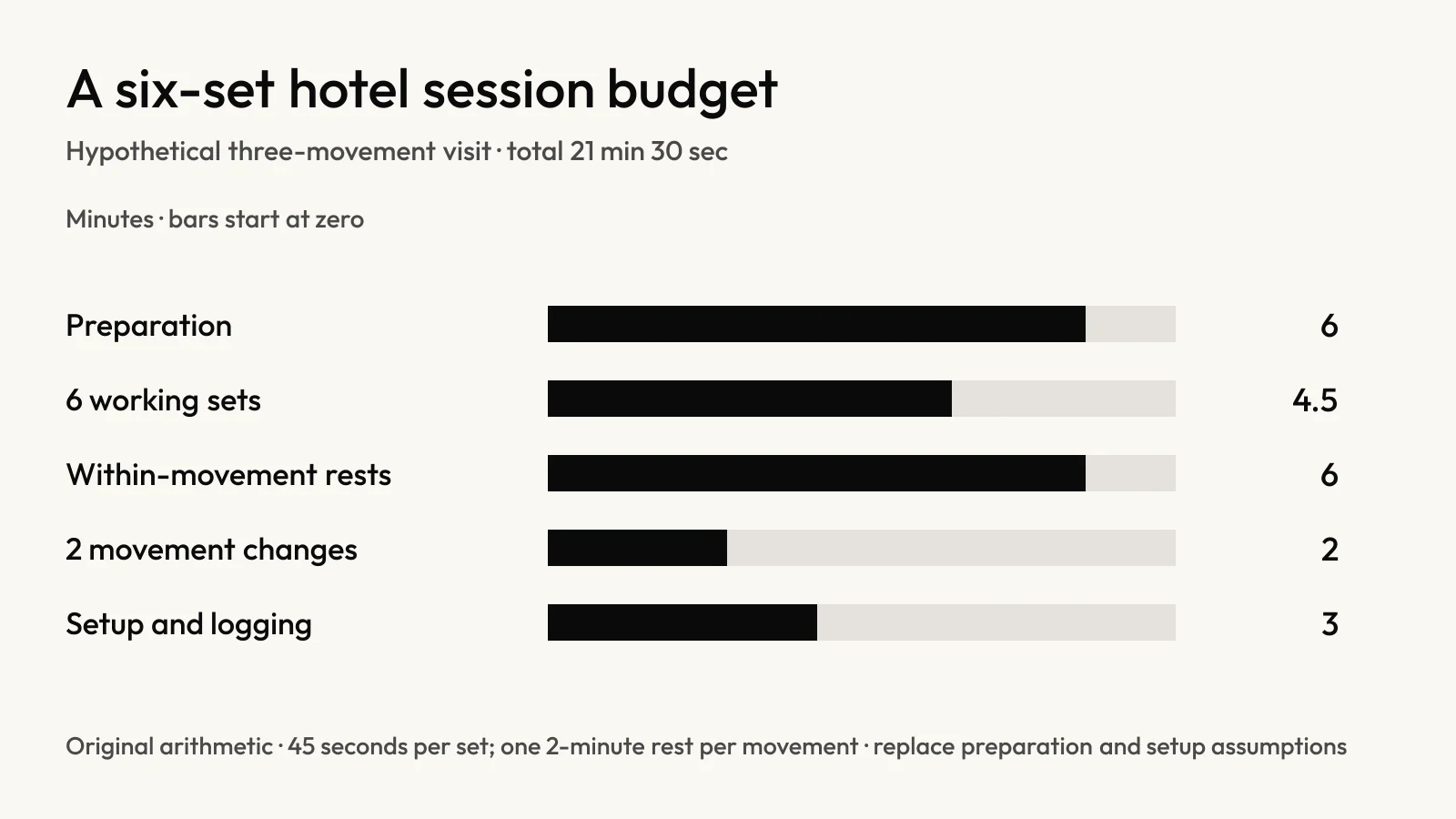
In the illustrative budget below, three familiar movements with two working sets each take 21 minutes 30 seconds. That leaves eight minutes 30 seconds inside a 30-minute slot.
Assume six minutes of preparation, 45 seconds per working set, two minutes of rest between the two sets of each movement, one minute to change movements and three minutes for setup and logging. These are accounting assumptions, without a claim that you need exactly these preparation or rest times.
| Task | 3 movements, 6 sets | 2 movements, 4 sets |
|---|---|---|
| Preparation | 6 min | 6 min |
| Working sets at 45 seconds | 4 min 30 sec | 3 min |
| Rests within movements | 6 min | 4 min |
| Movement changes | 2 min | 1 min |
| Setup and logging | 3 min | 3 min |
| Total | 21 min 30 sec | 17 min |
| Example appointment | 30 min | 20 min |
| Buffer | 8 min 30 sec | 3 min |
Each two-set movement has one rest between its working sets. The model counts a movement change separately and assumes you can begin the next movement after that interval. Add time if you need more recovery, preparation or setup.
Pick the actual exercises before using the table. More preparation, longer sets or a station wait can consume the buffer. The rest-between-sets guide and warm-up article explain why those entries belong to the task you will perform.
Which exercises could fill those two example budgets?
A familiar squat, floor press and row can fill the six-set example without a bench. The four-set option below retains the squat and row, deferring the press; choose the priorities that fit your own programme.
This is an illustrative session for an adult who already knows these movements and uses an 8–12-repetition range with some repetitions in reserve. Retain your own programme’s target effort, choose each movement’s own controllable load and stop for pain or loss of control. Ask a coach about unfamiliar movements; the table does not teach technique or establish suitability for you.
| Familiar movement | 30-minute example | 20-minute example | Load convention |
|---|---|---|---|
| Goblet squat | 2 working sets, 8–12 reps each | 2 working sets, 8–12 reps each | One dumbbell, its own total load |
| Dumbbell floor press | 2 working sets, 8–12 reps each | Deferred | Record each hand’s load |
| Familiar unsupported dumbbell row | 2 working sets, 8–12 reps each | 2 working sets, 8–12 reps each | Record each hand’s load; choose a variation you know |
| Total | 6 working sets | 4 working sets | No kilogram exchange rate between movements |
Prepare for the retained movements before working sets. The budget assumes 45 seconds per set and two minutes between the two sets of each movement; check your actual pace and recovery. If a different row takes one side at a time, account for both sides instead of using the table’s simultaneous two-dumbbell set time.
The six-set choice does not include a separate hip-hinge or vertical-press movement. The four-set choice also omits pressing. These are selected travel priorities, not complete substitutes for your usual week. Record those omissions, then review the return session with your programme or coach.
What should you do if you have only 20 minutes?
Choose fewer priorities and recalculate the budget. Under the same assumptions, two movements with two working sets each take 17 minutes, leaving three minutes in a 20-minute slot.
Select the two movements from your programme rather than taking the first two dumbbell exercises you see. Record the omitted work beside the session. The arithmetic does not show that four sets and six sets produce equal outcomes, or that either option replaces your full weekly programme.
If the actual preparation and setup leave too little time, choose another slot or discuss a different plan with your coach. For a trip where training cannot fit, the week-off-gym evidence explains what the short-break study measured and its limits.
How should you record unfamiliar dumbbell labels?
Write the unit and whether the number describes one dumbbell or the pair. Keep hotel results under the exercise and equipment you used.
Two dumbbells marked 10 kg mean 10 kg per hand and 20 kg combined. A barbell entry marked 20 kg may describe the total load. Those conventions explain the arithmetic; they do not make the exercises equivalent.
For a hypothetical six-set visit, record the three movement names, both sets’ completed repetitions and the per-hand load. Add “hotel rack, maximum pair available: 10 kg each” if that limitation affected your choice. Keep pounds as pounds if you cannot confirm a conversion or the rack’s label.
When you return to your regular gym, compare its exercises with their own previous records. Use the progression guide for the next target. A larger total from different equipment does not establish a personal record for the original lift.
How do you place the session within a short trip?
Choose appointments that fit travel and the rest of your programme, then keep a return plan. A temporary session should have a stated role rather than a promise to maintain every usual result.
For a hypothetical three-night trip, you might find one 30-minute gym appointment that fits your existing plan. Check the room at arrival, choose the work and record what you complete. This describes a calendar example, without prescribing a training frequency for all travellers.
Leave the hotel alternatives in the travel log and review your regular session when you return. The temporary gym-closure example shows another way to keep adapted sessions alongside a return decision.
Which sources support this answer?
The ACSM position stand concerns resistance training in healthy adults across programmes lasting weeks. It does not test this short travel session or guarantee maintenance of a particular lift. The equipment checklist and time budgets are editorial examples with stated assumptions. The abstract and full publisher text were read, and the DOI destination checked, on 15 October 2026.
Topic: Dumbbell training. Planning a temporary resistance-training session from a hotel gym’s equipment inventory and a stated time budget.
Liftor is not a doctor and gives no medical advice.