Training
Can you build muscle with two workouts a week?
Yes. Two weekly resistance-training sessions can support muscle growth. Count the work each muscle gets across the week before judging the schedule. A 2019 review of 25 studies found no meaningful hypertrophy difference between training a muscle more or fewer times a week when weekly volume was equated. The useful question is what your two sessions contain.
Updated: Added related reading on combined-session order and calculated shorter-session options.
What does the research say about training twice a week?
Twice-weekly training is a viable studied option. It is not established as the best schedule for every person.
Currier and colleagues’ 2023 review included 119 studies and 3,364 participants in its muscle-growth network, and compared prescriptions by load, sets and weekly training frequency. All the analysed prescriptions improved hypertrophy compared with controls. Higher-load, multiple-set training twice a week ranked highest, but ranking does not prove superiority over every other prescription. The network meta-analysis concerns supervised training in healthy adults, with uncertainty around comparisons.
Two days a week also meets the NHS guideline for adults, which asks for strengthening activities that work all the major muscle groups on at least two days a week. Count the legs, hips, back, abdomen, chest, shoulders and arms across your two sessions.
Does twice a week mean two gym visits or two sessions per muscle?
Two gym visits count attendance. Training a muscle twice counts its exposure to work. Those numbers match only if your routine makes them match.
A full-body routine can include lower-body work, a press and a pull on both visits. A two-day upper/lower split puts upper-body work on one visit and lower-body work on the other. Calling both routines “twice a week” hides that difference. The reviews below do not count the same thing either: Schoenfeld and colleagues analysed how many times a week each muscle group was trained, while Currier and colleagues grouped whole prescriptions by weekly frequency. A four-day upper/lower routine is another schedule again: it takes four visits to train each half twice.
Write your actual days at the top of the plan. For this example they are Monday and Thursday. Below each day, list the exercises you can perform in the available room or gym. Count their working sets across both days. Keep warm-up sets in a separate column so the plan shows what you intend to compare.
The training topic covers the wider planning questions. Here, the constraint is two visits that you can repeat.
How can you compare full-body and upper/lower plans fairly?
Compare the weekly exercise sets before comparing the split’s name. Otherwise you can change the amount of work and its distribution at the same time.
This small ledger uses four familiar exercises: a squat, a hip hinge, a press and a row. It illustrates the arithmetic, rather than providing a complete programme for every muscle.
| Two-day layout | Monday | Thursday | Weekly total |
|---|---|---|---|
| Full body | 2 squat + 2 hinge + 2 press + 2 row | 2 squat + 2 hinge + 2 press + 2 row | 4 sets per exercise; 16 total |
| Upper/lower with fewer sets | 2 press + 2 row | 2 squat + 2 hinge | 2 sets per exercise; 8 total |
| Upper/lower with equal sets | 4 press + 4 row | 4 squat + 4 hinge | 4 sets per exercise; 16 total |
The first and second rows differ in both weekly sets and frequency. The first and third rows retain the same exercise-set totals while distributing them differently. They still need matched exercises, loads, movement and effort before you can call the workload comparable.
These are exercise counts, not a precise count for each muscle. A press involves several muscles; squat and hinge contributions also overlap. Do not add every compound set to every involved muscle and treat the result as a measured training dose. Add other exercises where your programme requires them, then redo the ledger.
Illustrative: same exercise totals, different distribution
Full body on both visits
Monday: 2 squat + 2 hinge + 2 press + 2 row
Thursday: 2 squat + 2 hinge + 2 press + 2 row
16 weekly sets
4 sets per exercise across two visits.
Upper/lower with equal sets
Monday: 4 press + 4 row
Thursday: 4 squat + 4 hinge
16 weekly sets
4 sets per exercise on one visit.
Editorial arithmetic for the four named exercises. Equal counts do not establish equal training effects or a precise set dose for each muscle. Match exercises, loads, movement and effort when comparing work.
Must each muscle be trained twice for growth?
The 2019 review analysed how often each muscle group was trained, and it does not make twice-per-muscle training a universal requirement. Weekly volume matters to the comparison.
Schoenfeld, Grgic and Krieger’s 2019 frequency review examined 25 studies. Higher frequency had no meaningful hypertrophy advantage with equated volume, and a modest advantage with unequal volume.
Choose the layout that lets you complete the intended workload. Record the sets you perform before changing the split’s name.
Can one full-body session fit into 45 minutes?
Each of the two full-body sessions can fit under some assumptions. Calculate the session before booking it into a 45-minute gap, then replace the estimates with your observed times.
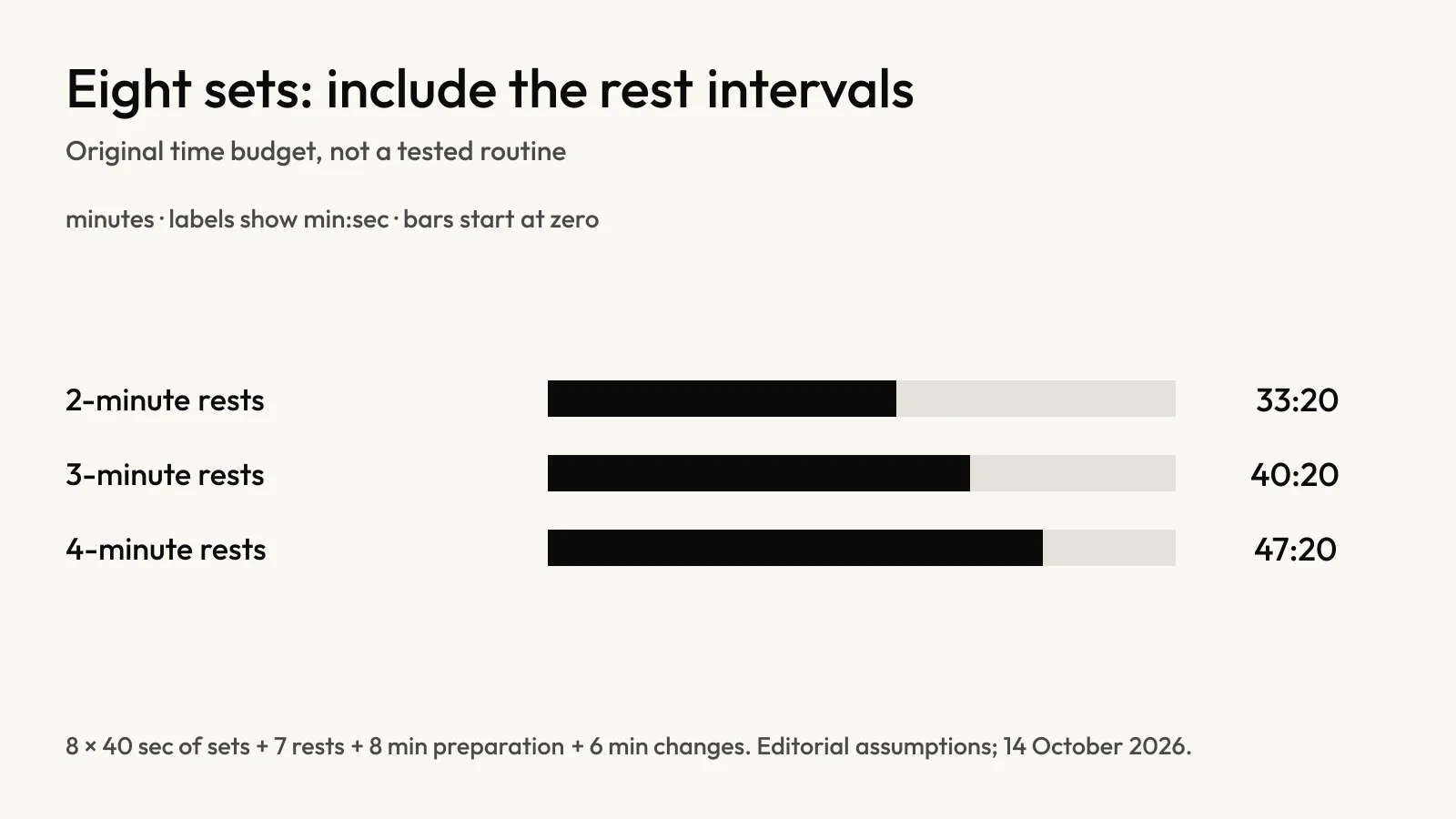
Take eight working sets from the first table. Assume each takes 40 seconds, allow seven rest intervals, eight minutes for preparation and warm-up sets, and six minutes for equipment changes. Those values are editorial inputs, not recommended set duration, warm-up duration or rest limits.
| Part | Calculation | Time |
|---|---|---|
| Working sets | 8 × 40 seconds | 5 min 20 sec |
| Rest, first scenario | 7 × 2 minutes | 14 minutes |
| Preparation and warm-up | Editorial allowance | 8 minutes |
| Equipment changes | Editorial allowance | 6 minutes |
| Total | 5:20 + 14:00 + 8:00 + 6:00 | 33 min 20 sec |
At three minutes per rest interval the total becomes 40 minutes 20 seconds. At four minutes it becomes 47 minutes 20 seconds, which exceeds the 45-minute slot. Queues, travel, changing and showering add time outside these totals. The rest-between-sets guide covers rest decisions; this calculation makes their time cost visible.
What should you change when the plan takes too long?
Change the planned work or the available slot when your observed session exceeds it. Keep enough time to prepare and perform the exercises you retain.
Time two sessions from the start of preparation to the end of the last set. Record queues and equipment changes separately. If a 45-minute booking takes 55 minutes on both days, include that ten-minute difference when reserving your next session.
You could choose fewer exercises, fewer sets, a less busy time or a longer slot. Each choice changes something specific. Removing one exercise from both sessions changes its weekly work; removing one set from each exercise changes the whole ledger. Write the change beside the plan so you can see what you are testing.
A shorter rest interval also changes the session. Use the reps you complete and your intended reps in reserve to check whether the revised plan still lets you perform the work as intended.
How do you judge whether the two-day plan is working?
Track attendance and comparable working sets first. A log shows whether you can perform the plan; it does not measure muscle growth.
Record the exercise, equipment, load, repetitions, sets and stopping point. Keep those conditions consistent when comparing sessions. Twelve repetitions on a different machine are not a clean comparison with ten on the previous machine. A rep increase with a changed range of movement needs the same caution.
Review the weeks you completed rather than the ideal week on paper. If you keep completing one of two planned sessions, choose two days you can attend before adding work. If both happen and the planned sets remain repeatable, use the progressive-overload guide for decisions about progression. More days are not the only way to change a programme.
What if you miss one of the two sessions?
Check the next available slot and resume from a recorded plan. You do not need to double the remaining session to make the calendar look complete.
A full-body schedule leaves a record of the work you completed across the body on the other day. An upper/lower schedule shows which half missed its planned visit. That is useful information for choosing the next session, rather than a reason to squeeze every missed set into an unsuitable gap.
For a longer interruption, the week-off-gym evidence explains what the relevant trials can establish. If you plan a lighter week, use the deload guide. Keep a record of the reason and the date you expect to return to your usual schedule.
Who should get advice before starting?
Speak to your doctor first if you have not exercised for some time, or if you have medical conditions or concerns. Choose activity and intensity appropriate to your fitness.
This is the advice in the NHS adult activity guidance. The illustrative routine cannot assess a health problem or replace guidance you have received about one.
Which sources support this answer?
These reviews compare resistance-training prescriptions and muscle-size outcomes. The programme and timing tables are editorial calculations, not study routines or personalised prescriptions.
- Schoenfeld, Grgic and Krieger (2019). How many times per week should a muscle be trained to maximize muscle hypertrophy? Systematic review and meta-analysis, 25 studies; PMID 30558493.
- Currier et al. (2023). Resistance training prescription for muscle strength and hypertrophy in healthy adults: a systematic review and Bayesian network meta-analysis. British Journal of Sports Medicine. Hypertrophy network: 119 studies, 3,364 participants; PubMed PMID 37414459.
- NHS (reviewed 22 May 2024). Physical activity guidelines for adults aged 19 to 64. Strengthening activities on at least 2 days a week, and advice before starting or returning to exercise.
Topic: Resistance training frequency. Planning resistance-training work across two weekly sessions.
Liftor is not a doctor and gives no medical advice.