Training
Should you do cardio before or after weights?
Do the training you want to improve most first. Put weights first when lifting performance is the priority, and your main cardio first when endurance is the priority. An easy warm-up is a separate task. Combining both can work; the order, effort and time available affect what you can complete.
Updated: Added a diagram showing how the same illustrative hour changes order with the training priority.
Which part should you do first?
Start with the part whose performance you want to protect. Write that priority before allocating minutes to the session.
For a lifting-focused day, prepare for your lifts, complete the planned resistance work and then do the endurance work you can fit. For a running-focused day, prepare for the run and do that work first. You still need appropriate preparation before a later lifting block. Choosing the order does not remove a task from the timetable.
Use a concrete goal, such as completing the prescribed squat sets or practising a planned run. “Fitness” alone does not tell you which task should receive the first part of the hour. If a coach wrote both sessions, ask which takes priority that day and which work you can defer.
| Today’s priority | First main block | Check before the later block |
|---|---|---|
| Planned lifting performance | Weights after preparation | Time and capacity for the intended cardio |
| Planned endurance performance | Cardio after preparation | Readiness to prepare for and control the lifts |
| Both have demanding targets | Use the programme’s priority | Whether separate sessions fit your week |
Does a cardio warm-up count as doing cardio first?
A brief easy warm-up and your main endurance session serve different purposes. Keep them as separate entries when deciding the order.
A few easy minutes before weights need not represent the running or cycling work you planned to improve. Put that preparation in the budget, then name the main endurance block: its activity, intended duration and effort. This avoids using the same word, cardio, for a short preparation task and a demanding session.
General preparation also differs from the practice sets for a particular lift. Use the warm-up-set guide for the reference load and the limits of a fixed percentage rule. In the example below, eight minutes cover illustrative lift preparation. Your actual preparation may take longer; change the timetable to match it.
What does research say about weights before cardio?
One order review favoured weights first for lower-body dynamic strength, while several other outcomes showed no detected order effect. That finding supports a lifting priority without promising a particular gain.
Eddens and colleagues’ 2018 meta-analysis included ten studies lasting at least five weeks in healthy adults. Resistance work before endurance work favoured lower-body dynamic strength by 6.91 percentage points in the change from baseline, with a 95% confidence interval of 1.96 to 11.87. The researchers did not detect order effects for hypertrophy, static strength, aerobic capacity or body-fat percentage. Eddens et al., 2018
The pooled number describes the study comparison. It does not mean that moving your treadmill work guarantees another 6.91% on your squat. The review also cannot tell you the best order for a session you have not defined. Record the activities and your priority before applying its conclusion.
Will combining cardio and weights prevent muscle growth?
The updated concurrent-training review did not detect a pooled disadvantage for muscle size or maximal strength. Explosive strength had a different result, so separate those outcomes.
Schumann and colleagues’ 2022 meta-analysis included 43 studies comparing combined aerobic and resistance training with resistance training alone. Standardised mean differences were −0.01 for hypertrophy, −0.06 for maximal strength and −0.28 for explosive strength. The first two comparisons showed no significant pooled difference; explosive-strength gains were attenuated with combined training. Schumann et al., 2022
Those are group comparisons across training programmes, rather than results for a particular 20-minute run. A jump, a maximal lift and muscle size also measure different things. A programme designed for explosive performance deserves its own scheduling decision; a general lifting session does not become a power programme because you add a few jumps.
How can both fit into a 60-minute session?
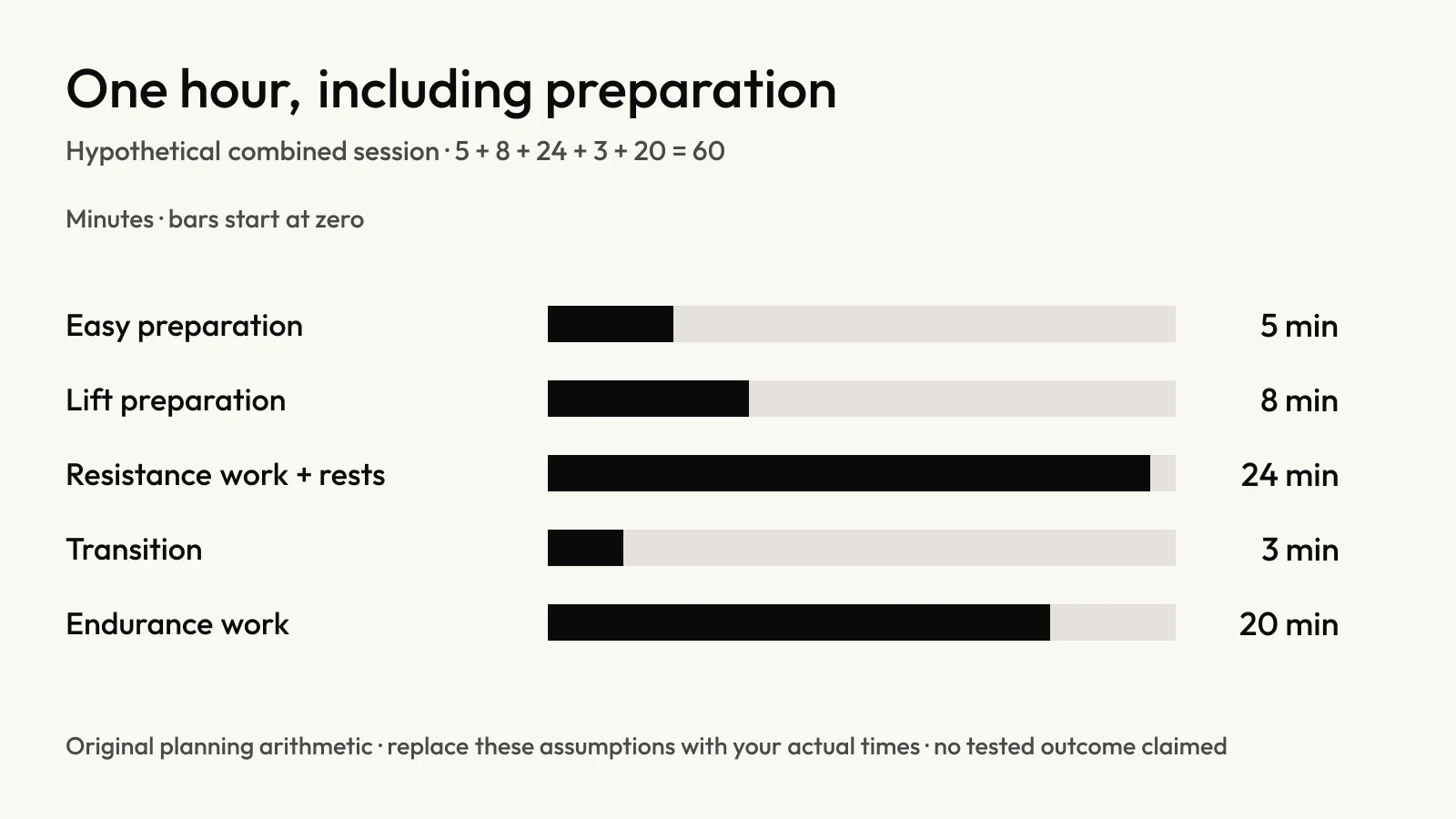
Count preparation and transitions alongside the main work. The illustrative allocation below uses the full hour before you add any extra sets or travel.
| Task | Illustrative minutes | What the entry covers |
|---|---|---|
| Easy general preparation | 5 | Preparation for the first main activity |
| Lift-specific preparation | 8 | Familiar practice sets and checks |
| Resistance work | 24 | Working sets and their planned rests |
| Transition | 3 | Move, set up and record |
| Main endurance work | 20 | The planned cardio block |
| Total | 60 | 5 + 8 + 24 + 3 + 20 |
Choose the priority, then order the hour
Lifting priority
- General preparation 5 minutes
- Lift preparation 8 minutes
- Weights 24 minutes
- Transition 3 minutes
- Main endurance work 20 minutes
Endurance priority
- General preparation 5 minutes
- Main endurance work 20 minutes
- Transition 3 minutes
- Lift preparation 8 minutes
- Weights 24 minutes
Both orders total 60 minutes with no buffer. These are the table’s planning assumptions, without a tested outcome or universal preparation time. Change the allocations to fit the activities you will perform.
The same arithmetic leaves zero spare minutes. A station queue, a longer warm-up or extra rest means you need another choice. Reduce or move some work with your coach instead of treating the hour as proof that all five tasks will fit. The table supplies a planning example, without assigning a universal warm-up duration or an outcome to the 24-minute block.
What should you change if the session runs late?
Protect the priority you chose and record the work you defer. Keep the preparation and rest needed to perform the remaining work under control.
Suppose you reach the endurance block with 12 minutes left instead of 20. Your log should say 12 minutes completed and eight deferred, if that is the choice you make. It should not record a full 20-minute session. Ask your coach whether to shorten that block or move the planned work elsewhere in the week.
Use the rest-between-sets guide to choose rests for the lifting task. Then include those rests in its allocation. A timetable that fits only because you omit rest from the arithmetic will not describe the session you intended to perform.
Should you separate cardio and weights by several hours?
Separate sessions can help a demanding programme, but the reviewed evidence does not make a fixed gap compulsory for every combined workout.
In Schumann’s review, explosive-strength attenuation was more pronounced when both modes shared a session than when the researchers separated them by at least three hours. That subgroup result concerns explosive strength. It does not establish a magic waiting period that guarantees recovery for your two sessions.
Check the practical cost before choosing a split day. Two gym journeys, two changing periods and two preparation blocks need real time. The two-workouts-a-week example shows why a session count and a set count answer different questions. Separate work only when the resulting week remains something you can carry out.
Does one difficult combined session show an interference effect?
One difficult session records what you could perform that day. It cannot establish the longer-term training effects measured by the reviews.
In the one-hour example, record whether you completed the planned resistance block and the 20-minute endurance block. Add which went first and whether you changed the prescribed task. A run that felt harder after weights gives you a practical scheduling observation; it does not measure a change in muscle size.
Compare like-for-like appointments if you review the order with a coach. Keep the exercises, planned work and equipment identifiable. A shorter session with a new exercise and different rest periods gives you several possible explanations for its result. Choose the next trial of the timetable with that limitation visible, rather than treating a single visit as a verdict on combined training.
What should you record to choose next time?
Record the order, actual work and any reason you changed the plan. Compare similar sessions before drawing a conclusion from one difficult day.
Write the lifting exercises, loads and repetitions beside the cardio activity, minutes and intended effort. Add whether equipment access or your available time changed. If you changed exercises, follow the exercise-substitution recording method so results stay under the movement you performed.
Keep the day within your wider programme. The periodisation guide explains planned changes across a block, while the training topic collects session examples. This advice covers healthy adults planning familiar exercise. Ask a doctor first if a medical condition, recent injury or concerning symptoms affect exercise; ask your coach about unfamiliar or demanding combinations.
Which sources support this answer?
The two systematic reviews address different comparisons: exercise order within combined training, and combined training compared with resistance training alone. The 60-minute schedule is our arithmetic example. Neither review tested that schedule or establishes an individual result from it. Abstracts read on PubMed and DOI destinations checked on 15 October 2026.
- Eddens, van Someren and Howatson (2018). The Role of Intra-Session Exercise Sequence in the Interference Effect: A Systematic Review with Meta-Analysis. Sports Medicine, 48:177–188. Ten studies.
- Schumann et al. (2022). Compatibility of Concurrent Aerobic and Strength Training for Skeletal Muscle Size and Function: An Updated Systematic Review and Meta-Analysis. Sports Medicine, 52:601–612. Forty-three studies.
Topic: Concurrent training. Ordering resistance and endurance work within a session, with separate preparation, transition and training time.
Download for iPhone to plan your training with Liftor.
Liftor is not a doctor and gives no medical advice.