Training
How do you shorten a workout when you have less time?
Shorten a workout by choosing which planned work to keep, counting warm-up, rest and setup, then deferring the rest. A 30-minute slot may need fewer sets or movements than your usual 45 minutes. Use a time budget before starting, and record what you completed so you can review the next session.
How much training time do you have?
Count the minutes from starting your preparation to the time you must finish. A 30-minute gap between meetings gives you less training time if you need to change clothes, reach the gym or shower within that gap.
Write down the departure time first. Then list the parts you need to fit before it: equipment setup, warm-up, working sets and their rests. Include loading plates and moving between stations. Check your own recent sessions for these times rather than assigning the whole slot to lifting.
For a session at home, travel may disappear from the calculation; clearing a space and putting equipment away still takes time. The training topic hub covers the training decisions around this planning method.
Which parts should you keep?
Keep the preparation your chosen exercises need and the rest you planned between their sets. Choose the movements that address the purpose of today’s session from exercises you know how to perform.
Start with your existing programme or your coach’s instructions. Mark the work you want to prioritise, then identify the work you can defer. A technique session, a strength session and a general training day may have different priorities. Avoid copying another person’s shortened exercise list because their goal and experience may differ.
Use the warm-up sets article to distinguish preparation from working sets. A shorter appointment does not establish that you need less preparation. Count the warm-up you expect to need for the movements you retain, then cut the planned work to fit the remaining time.
How do you calculate the session budget?
Add preparation, working-set time, rests and transitions, then leave a buffer for delays. The arithmetic below uses hypothetical times; measure your own session before treating any row as a prediction.
Suppose you planned four movements with three working sets each in a 45-minute slot. Assume each working set takes 45 seconds, with two minutes between working sets of the same movement. Allow one minute to change stations, eight minutes for the warm-up and four minutes for setup and logging.
| Part | Calculation | Minutes |
|---|---|---|
| Warm-up | Stated assumption | 8 |
| Working sets | 12 × 45 seconds | 9 |
| Rests within movements | 4 × 2 rests × 2 minutes | 16 |
| Changes between movements | 3 × 1 minute | 3 |
| Setup and logging | Stated assumption | 4 |
| Total | 8 + 9 + 16 + 3 + 4 | 40 |
You have five minutes left inside the original slot. Three sets need two rests between them. This model counts the change to the next movement as a separate minute and assumes you are ready to start after it. Add more time if your movement change requires a longer break or extra preparation.
Which two versions fit a 30-minute slot?
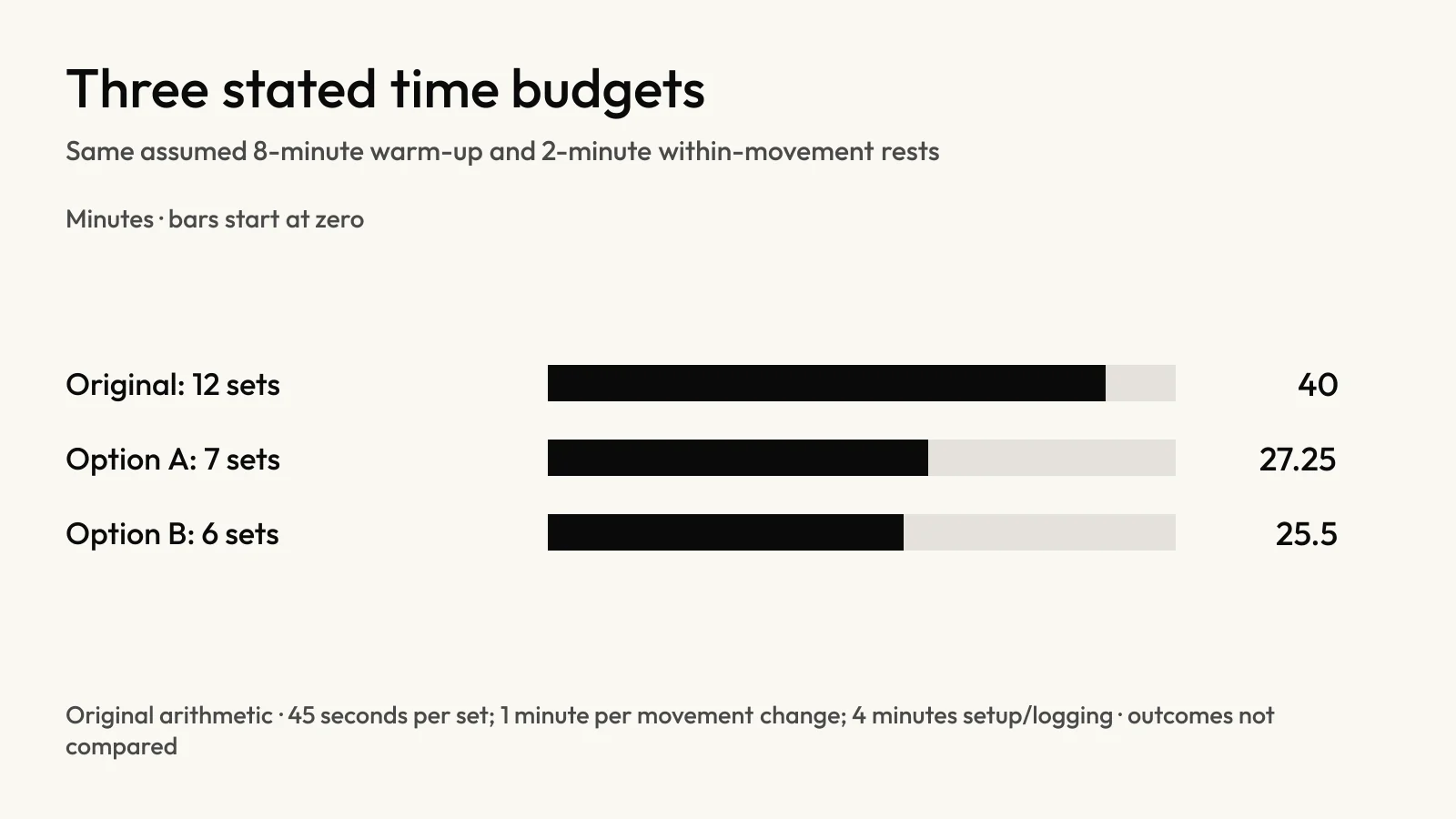
In this example, seven sets across three movements take 27 minutes 15 seconds, while six sets across two movements take 25 minutes 30 seconds. Both options retain the eight-minute warm-up and two-minute rests within a movement.
| Part | Original | Option A | Option B |
|---|---|---|---|
| Movements | 4 | 3 | 2 |
| Sets per movement | 3, 3, 3, 3 | 3, 2, 2 | 3, 3 |
| Working sets | 12 | 7 | 6 |
| Working-set time | 9 min | 5 min 15 sec | 4 min 30 sec |
| Rests within movements | 16 min | 8 min | 8 min |
| Movement changes | 3 min | 2 min | 1 min |
| Warm-up | 8 min | 8 min | 8 min |
| Setup and logging | 4 min | 4 min | 4 min |
| Total | 40 min | 27 min 15 sec | 25 min 30 sec |
| Buffer in available slot | 5 min of 45 | 2 min 45 sec of 30 | 4 min 30 sec of 30 |
Option A retains more movement variety. Option B gives you more time for delays and retains three sets for each of two priorities. These are clock examples, without claims about muscle growth or equal training results.
Removing the fourth movement alone would leave nine sets across three movements: 32 minutes 45 seconds under these assumptions. You would still exceed the 30-minute slot.
Should you shorten the rest periods?
Retain the rest your session needs unless you have a reason to change the training method. Saving time by cutting work gives you a clearer record of what changed than rushing the same list.
The two-minute rest in the table is an assumption for the calculation, rather than a recommendation for each exercise. Use your programme and the rest-between-sets guide to decide the interval you need. Set durations also vary; a 45-second row does not tell you to hurry your repetitions.
Finish a set with control, record it, then take the rest you planned. If the session runs late, stop before the next planned movement or set and record the omission.
How do you handle a busy station?
Count waiting time against the remaining budget and decide whether to wait, use a familiar replacement or defer that movement. A seven-minute queue removes seven minutes from the time you can use.
A replacement can also require its own preparation, loading and adjustment. Check those costs before assuming it saves time. The exercise-substitution method explains how to keep completed work separate from the replacement’s sets and loads.
Choose an alternative you know and can perform with the available equipment. A short appointment gives you little time to learn a new movement. Retaining two familiar priorities may fit the session better than moving through several unfamiliar stations.
Where should the deferred sets go?
Record deferred work and review whether it belongs in another session. Avoid adding the whole remainder to tomorrow without checking the workload you have planned there.
Write completed set counts beside the original prescription. In Option A, you completed seven of twelve working sets. Name the five you omitted, then decide whether to reschedule some, leave them out for this week or revise the programme with your coach.
The two-workouts-a-week article shows how distributing sets changes a weekly layout. It does not establish that these two shortened options match your original programme’s results. Use the progressive-overload guide for progression decisions after recording comparable work.
What should you change if the shorter slot is regular?
Set the programme around the time you expect to have instead of editing a longer workout at each visit. Keep actual session timings, including queues and setup, to check whether your proposed schedule fits.
A repeated 30-minute limit calls for a different planning conversation from one late arrival. Tell your coach which days are short and which allow more time. Review the whole week before increasing the demands of the longer days.
Include travel and sleep in that conversation. The night-shift schedule article provides an appointment-planning example with those demands counted, rather than assuming the minutes on the gym floor are your whole commitment.
How do you change the session-length preference in Liftor?
In Liftor, open Settings, find Your practice and tap Review, then choose Session length. The screen offers 20, 30, 45, 60, 75 and 90 minutes, and labels this field “Tomorrow’s plan + next season”.
Choose the length that reflects your future appointments and check the next plan. Changing this preference does not resize the workout you have open. For today’s session, use the manual budget above and record what you complete.
Liftor treats session length as a planning target. Your pace, rest, warm-up and available equipment still affect the time you spend. Read Liftor’s features for the settings and their timing.
This method is for adults planning familiar exercise. Seek a clinician’s advice before adapting exercise if you have medical conditions or concerns, or have not exercised for some time, as the NHS adult activity guidance advises. A shorter session cannot settle a health concern.
Which sources support this answer?
The time budgets are editorial calculations with stated assumptions, rather than tested programmes or predictions of training results. Liftor’s approved Features page and app source supply the session-length choices and future-plan timing. NHS guidance supports the advice to seek medical guidance before exercise where relevant. Sources inspected on 15 October 2026.
- Liftor Features: Your Practice, session-length settings and when changes take effect. Checked against the iPhone app’s profile-overview screen, fitness constants and planning prompts on 15 October 2026.
- NHS. Physical activity guidelines for adults aged 19 to 64: advice for adults with medical conditions or concerns, or who have not exercised for some time.
Topic: Workout planning. Selecting retained and deferred resistance work from a measured appointment budget, with future session-length preferences.
Set your future session-length preference and check the next plan. Download for iPhone.
Liftor is not a doctor and gives no medical advice.