Real life
How do you build a night-shift workout schedule?
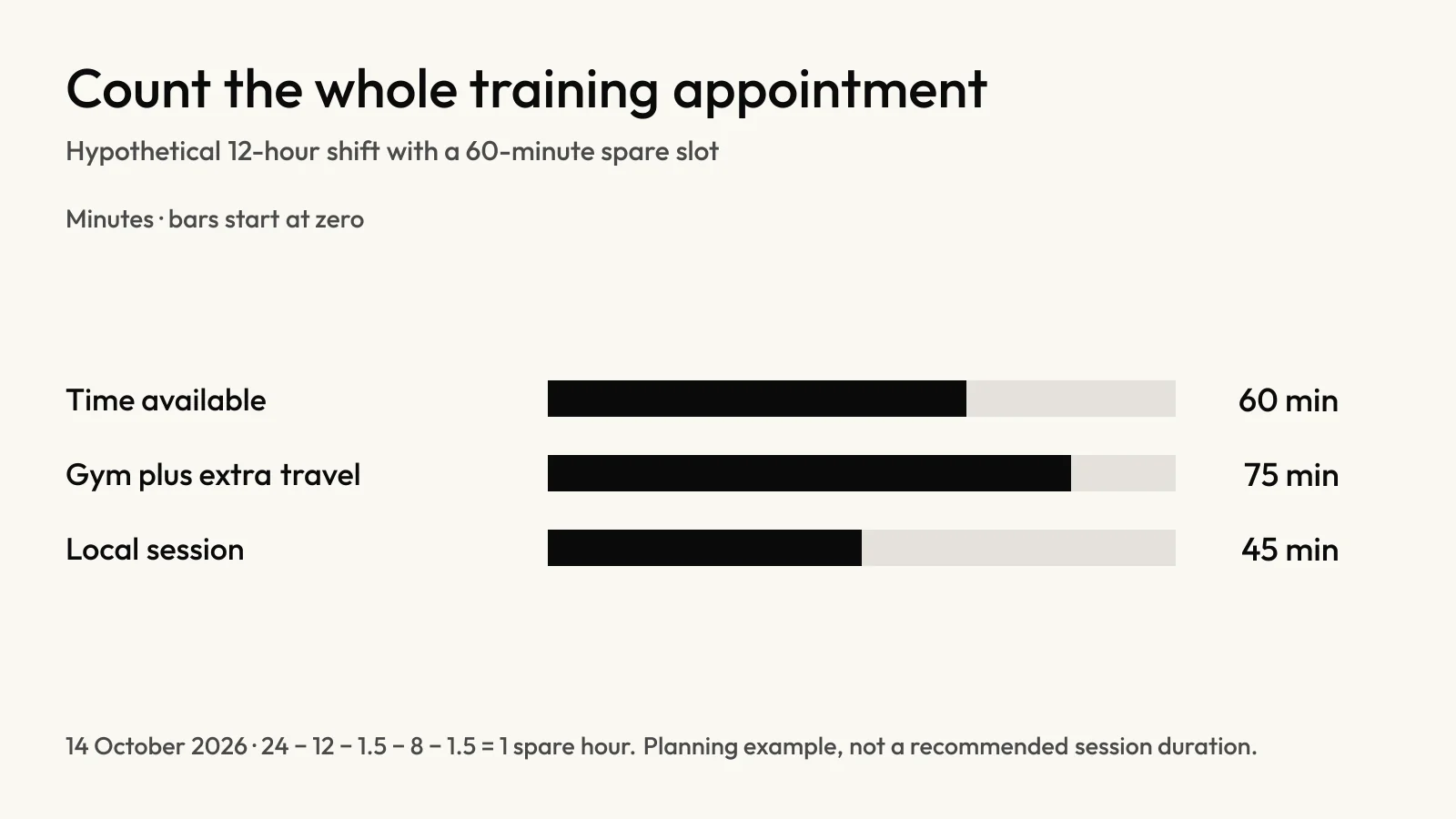
Put your shift, commute and sleep in the calendar before choosing a workout slot. Include the whole gym trip. In the example below, a 12-hour night shift leaves 60 minutes after sleep and daily tasks; a 45-minute workout with 30 minutes of travel needs 75. Choose a shorter trip or a day off.
Updated: Added related reading with retained and deferred work in a shorter-session budget.
What should you put in the calendar first?
Write the actual work hours, travel and sleep window first. Then include meals, washing and the responsibilities you need to meet at home.
A 19:00 start does not mean you can train until 18:55. You may need to leave at 18:15, change clothes and collect food before that. Use the departure time as the boundary. Include handover if it extends the shift.
NIOSH’s sleep module says, “Make sleep a priority.” It describes about seven to eight hours for most adults and individual differences in sleep need. The eight-hour block here is a planning input, not a personal prescription. Time reserved in bed does not prove you slept for eight hours.
A nurse in Mumbai, a security worker in Delhi and a customer-support worker serving another time zone can use the same subtraction. Their commute, rota and home responsibilities will produce different answers. The Real life topic covers changes to the week; this page addresses the overnight timetable.
How much time does a 12-hour night shift leave?
The example leaves one hour: 24 − 12 − 1.5 − 8 − 1.5 = 1. That hour must cover the whole training appointment.
The inputs describe one hypothetical day between consecutive night shifts. They do not represent a survey of workers or an ideal daily routine.
| Commitment | Hours |
|---|---|
| Work, 19:00–07:00 | 12 |
| Commute, 45 minutes each way | 1.5 |
| Protected sleep window | 8 |
| Meals, washing and preparation | 1.5 |
| Total committed | 23 |
| Unallocated | 1 |
Childcare, a longer handover or a delayed train needs its own row. Subtract those minutes before booking a workout. If your inputs exceed 24 hours, revise the commitments with the people involved; adding a training session cannot fix that timetable.
Why does the whole gym trip matter?
A 45-minute session plus 30 minutes of additional gym travel needs 75 minutes. It exceeds this example’s spare hour by 15 minutes.
Count travel beyond the work commute. A gym on the route may add ten minutes; another location may add thirty. Include entry, changing and any wait for equipment if your session estimate does not cover them.
| Option | Extra travel | Session | Total |
|---|---|---|---|
| Example gym trip | 30 min | 45 min | 75 min |
| Nearby or home appointment | 0 min | 45 min | 45 min |
| Shorter local appointment | 10 min | 30 min | 40 min |
These options compare time, not equal training effects. Choose familiar movements suited to the equipment you have. Keep the exercise-selection decisions in your programme, and use the rest-between-sets guide before shortening rests to squeeze work into the slot.
What could a pre-shift appointment look like?
A local 16:45–17:30 appointment fits the example after an 08:30–16:30 sleep window. It leaves time to wash, pack and depart at 18:15.
One possible sequence is home at 07:45, food and preparation until 08:30, reserved sleep until 16:30, then fifteen minutes before the session. Washing and packing take 17:30–18:00. The remaining fifteen minutes provide a buffer before the work commute.
Reserve sleep before the local training slot
- 07:45–08:30 · 45 minutes Home arrival, food and preparation.
- 08:30–16:30 · 8 hours Reserved sleep window.
- 16:30–16:45 · 15 minutes Time before the local appointment.
- 16:45–17:30 · 45 minutes Local training appointment, with no extra travel in this example.
- 17:30–18:00 · 30 minutes Wash and pack.
- 18:00–18:15 · 15 minutes Buffer before departure.
- 18:15–19:00 · 45 minutes Work commute before the 19:00–07:00 shift.
Original hypothetical timetable. An eight-hour reservation does not prove eight hours of sleep. Add your own home tasks and delays; the diagram does not prescribe sleep timing or training duration.
Use your own times. A family meal, a slower wake-up routine or a home task can consume that buffer. Add the task rather than calling it free time. A gym appointment also needs a confirmed opening time: a 24-hour sign does not establish access to a staffed service or a particular room.
This is a calendar that fits the stated inputs. It does not establish that pre-shift lifting is the best choice for you, that the sleep window will work, or that you can complete the planned session after that sleep.
Should you train after the shift instead?
Compare an after-shift appointment against the same sleep and travel budget. Do not add it after a full pre-shift session as an extra obligation.
Write down the new home-arrival time and the proposed sleep start. If the appointment delays both by an hour, the rest of the day needs that hour too. Check the next departure before accepting the change.
NIOSH’s driving module treats shift work and long hours as drowsy-driving risks. If you are too sleepy to travel or handle equipment safely, remove the training trip and arrange safe transport or rest. A workout is not a remedy for drowsiness.
Ask a doctor or occupational-health professional for help with persistent sleep difficulty or excessive sleepiness. If you have an injury, a condition affecting exercise or advice restricting activity, check the proposed routine with your clinician first.
How do you place sessions across a run of shifts?
Mark the appointments you can keep across the whole rota, including the changeover day. Put demanding gym trips on days with enough time after sleep and home tasks.
For a hypothetical four-night run, you might reserve one local appointment before the second shift and one gym appointment on a later day off. That example counts availability; it does not prescribe training frequency. If your rota allows two appointments a week, the twice-weekly training article shows how to count the work across them. Use the periodisation guide to place the changed week in a longer programme.
On the first day off, record the end of the final shift before writing “free day”. A 07:00 finish still belongs in its time budget. Keep the transition day’s sleep decision separate from the gym booking.
NIOSH’s night-shift module says it does not give a single strategy for rotating schedules and recommends specialist guidance if adjustment is difficult. A timetable cannot prescribe how to change your sleep rhythm between nights and days.
What should change when overtime removes the slot?
Recalculate the spare time and move or remove the appointment. Preserve the sleep window you planned before training.
In the example, one extra hour of work uses the full spare hour. A local 45-minute session no longer fits the same commitments. Choose a later suitable day, or leave this appointment out. Do not copy its unfinished sets onto the next day without reviewing that day’s programme.
Keep a short log: scheduled slot, actual sleep, travel delay and training completed. Read the readiness-score guide for the separate question of whether today’s planned work suits your condition. A score cannot create missing calendar time.
If overtime removes every appointment for a week, the week-off-gym article explains what one trial found about a week without training. Read it before squeezing in a rushed trip after an extended shift.
Which sources support this answer?
NIOSH’s shift-work training supplies the sleep priority, rotating-shift limits and driving guidance. The timetable and time-budget comparisons are original worked examples, not a tested intervention.
- NIOSH. Training for Nurses on Shift Work and Long Work Hours, Module 6: Improving Your Sleep and Alertness. Most adults need about 7–8 hours; individual needs vary. Reviewed 2020; read 14 October 2026.
- NIOSH. Module 9: Coping with the Night and Evening Shifts. Rotating schedules need individual guidance if adjustment is difficult. Reviewed 2020; read 14 October 2026.
- NIOSH. Module 11: Driving. Shift work, long hours and drowsy-driving precautions. Reviewed 2020; read 14 October 2026.
Topic: Shift work. Planning training around overnight work, travel and protected sleep time.
Liftor is not a doctor and gives no medical advice.