Recovery
What should you do on an active recovery day?
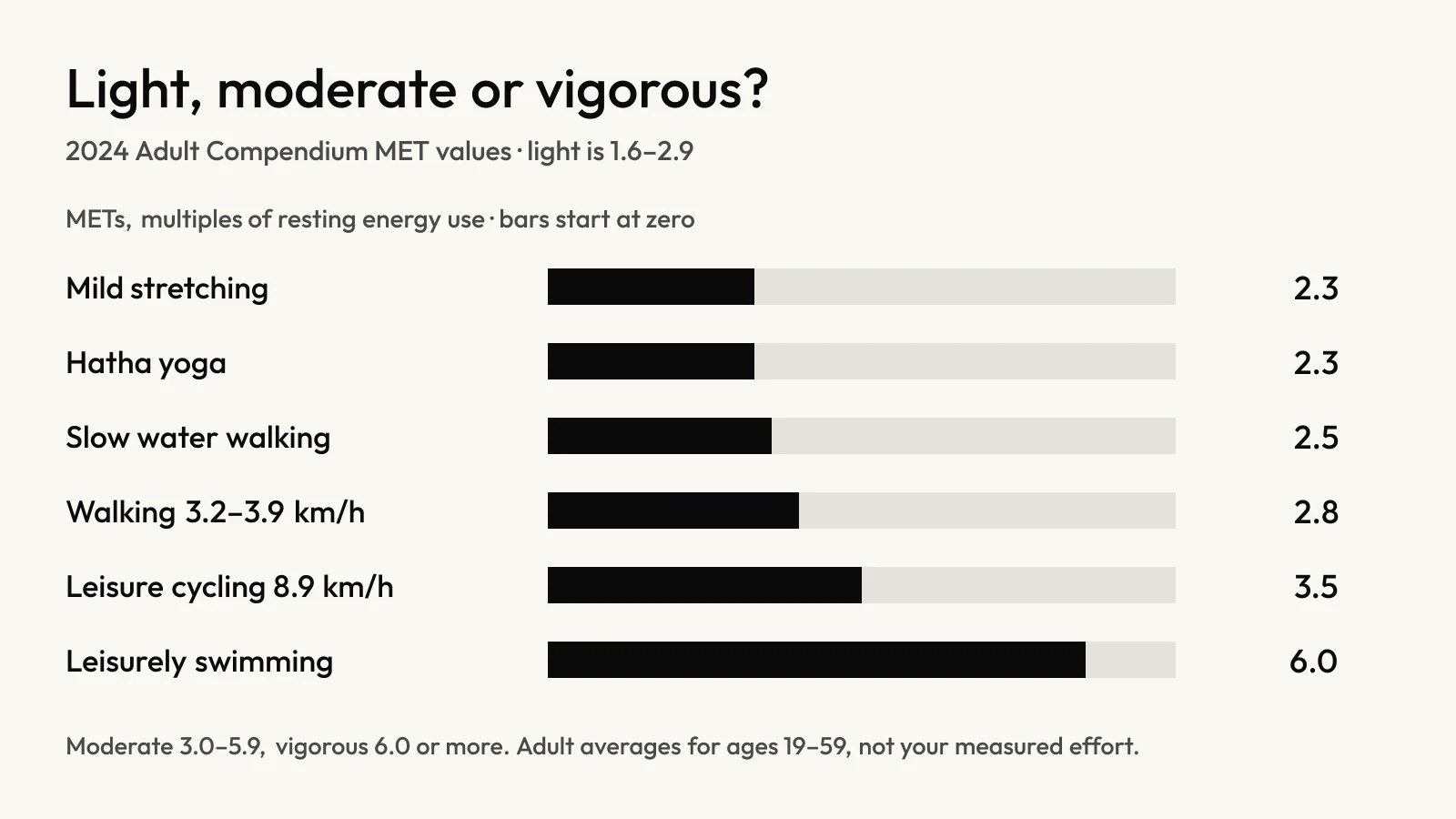
Choose light movement such as a slow walk, mild stretching, hatha yoga or slow water walking. The 2024 Adult Compendium rates each at 2.3 to 2.8 METs, inside its light band of 1.6 to 2.9. Leisurely swimming rates 6.0, which it classes as vigorous. Keep the movement shorter and easier than a training session, or rest.
Updated: Added light-activity options with 2024 Compendium MET values, guidance on effort, placement and duration, the size of the active-recovery evidence and Liftor’s rest-day step targets. New hero chart.
Light, moderate or vigorous?
2024 Adult Compendium MET values · light is 1.6–2.9
METs, multiples of resting energy use · bars start at zero
- Mild stretching2.3
- Hatha yoga2.3
- Slow water walking2.5
- Walking 3.2–3.9 km/h2.8
- Leisure cycling 8.9 km/h3.5
- Leisurely swimming6.0
Moderate 3.0–5.9, vigorous 6.0 or more. Adult averages for ages 19–59, not your measured effort.
What counts as active recovery?
Active recovery means light movement on a day without demanding training. Judge an activity by what you will do and how hard, whatever the calendar calls it.
The Compendium of Physical Activities grades effort in METs, multiples of resting energy use. Its 2024 adult edition sets one MET at 3.5 ml of oxygen per kilogram per minute and classes 1.6 to 2.9 METs as light, 3.0 to 5.9 as moderate and 6.0 or more as vigorous. Read the 2024 Compendium paper.
A competitive football match, a cycling interval session or several loaded squat sets adds a different demand. You can enjoy those activities, but count them as training when you plan the week.
Which light activities can you choose from?
Slow walking, mild stretching, hatha yoga, traditional mat Pilates and slow water walking sit in the Compendium’s light band. Walking at 4 km/h or faster, Surya Namaskar, leisure cycling and leisurely swimming sit higher.
| Activity (Compendium code) | METs | Band |
|---|---|---|
| Pilates, traditional mat (02103) | 1.8 | Light |
| Walking, strolling, under 3.2 km/h (17151) | 2.3 | Light |
| Stretching, mild (02101) | 2.3 | Light |
| Yoga, hatha (02150) | 2.3 | Light |
| Water walking, light effort, slow pace (18367) | 2.5 | Light |
| Walking, 3.2 to 3.9 km/h, slow pace (17152) | 2.8 | Light |
| Walking, 4.0 km/h (17170) | 3.0 | Moderate |
| Yoga, Surya Namaskar (02180) | 3.5 | Moderate |
| Cycling, leisure, 8.9 km/h (01018) | 3.5 | Moderate |
| Stationary cycling, 25 to 30 watts (01210) | 3.5 | Moderate |
| Swimming, leisurely, not laps (18310) | 6.0 | Vigorous |
Method: values come from the Compendium’s walking, conditioning exercise, water activities and bicycling lists. Speeds are converted from miles per hour at 1.609 km per mile and rounded. The values are averages for adults aged 19 to 59, and the Compendium’s authors note that a listed value may not reflect one person’s measured energy use. Browse the 2024 Adult Compendium lists.
The pool and the bike need the most care. Leisurely swimming sits at 6.0 METs, and the NHS lists swimming among its vigorous examples; slow water walking, at 2.5, is the light option in a pool. The Compendium describes stationary cycling at 25 to 30 watts as very light to light effort, yet rates it at 3.5 METs, in the moderate band.
How easy should active recovery feel?
Easier than the NHS description of moderate activity. That is this article’s planning rule: none of the sources on this page sets an intensity for active recovery. The NHS describes moderate activity as raising your heart rate and making you breathe faster while you can still talk, but not sing. Vigorous activity leaves you unable to say more than a few words without pausing for breath. NHS activity and intensity guidance.
Plan the light day below the moderate description. The NHS lists brisk walking and riding a bike among its moderate examples and says most moderate activities can become vigorous if you increase your effort. Set a slow pace and a flat route before you start, and keep the plan when you feel fresh halfway through.
Lifting sets use a different effort scale, covered in the RPE and RIR guide. Keep those ratings for training days.
Where should a light day go in the week?
Put it on the day or two after your hardest or least familiar session. Cheung and colleagues’ 2003 review of delayed-onset muscle soreness advises athletes who train daily to reduce exercise intensity and duration for one to two days after intense soreness-inducing exercise, or to train less-affected body parts instead. Read the soreness review.
| Day | Plan | Reason |
|---|---|---|
| Monday | Lower-body lifting with one new exercise | Hardest and least familiar session |
| Tuesday | Light day: slow walk and mild stretching | First day after that session |
| Wednesday | Upper-body lifting | Trains less-affected body parts |
| Thursday | Light day or rest | Between two lifting days |
| Friday | Full-body lifting | Third session |
| Saturday | Light day: slow walk | Day after the third session |
| Sunday | Rest | No planned activity |
The same review advises introducing eccentric or new exercises step by step over one or two weeks. This example puts activity on five or six of the seven days; the NHS advises spreading exercise evenly over 4 to 5 days a week, or every day. Write the light days into the plan before the week starts, and keep rest as the alternative on each.
How long should an active recovery session last?
Shorter than your usual training session. No source here sets a fixed duration, and Cheung’s review advises cutting duration as well as intensity after hard, soreness-inducing exercise.
As an editorial example, budget a 20-minute walk and 10 minutes of mild stretching: 20 + 10 = 30 minutes. You can use one part, both or neither. A person with a ten-minute window needs a different entry from a person with thirty minutes and no travel to add.
A daily step target measures something else. It counts the whole day’s walking, including errands and commuting, so it says nothing about the length of one session.
How do you make a light day concrete?
Write the activity, an effort description and a finish point. Include permission to shorten it or leave it out if it feels wrong for you on the day.
| Field | Example decision | Boundary |
|---|---|---|
| Activity | A familiar flat walk | No intervals or target pace |
| Effort | Below the NHS moderate description | Slow down if talking gets harder |
| Optional movement | Mild stretching you already know | Comfortable range; no forced position |
| End point | Finish after the planned slot | No extra circuit to make it feel productive |
| Alternative | Rest | A light day is not a test you must complete |
This is a planning template for adults without medical restrictions. Start from your usual activity and any guidance you have received; the last section covers when to rest or seek advice instead.
Does research establish an ideal recovery-day workout?
No. Dupuy and colleagues’ 2018 review pooled 99 studies of post-exercise recovery methods, with outcomes including soreness and perceived fatigue. Active recovery was one of several methods linked to a small to large decrease in delayed-onset muscle soreness; massage had the largest effect on soreness and fatigue. Read the recovery-methods review.
The 99 is the total across methods. The review’s active-recovery estimate for soreness drew on 8 experimental groups and 90 participants, and active recovery showed no clear effect on perceived fatigue. The authors add that its effect on soreness has been significant only for a short period after exercise.
Those studies tested recovery sessions after exercise, which differs from choosing tomorrow’s activity. A soreness score also does not show that you will lift more next time. The soreness article explains why discomfort is a poor way to measure muscle growth.
How can a recovery day turn into another training day?
You turn a recovery day into training when you add working sets or push your effort. Count the work you plan to do before deciding that the day is light.
Consider two hypothetical entries. One contains an easy walk for twenty minutes and mild stretching for ten. The other contains four sets of eight loaded squats under a heading called Active Recovery. The second entry still contains four working sets and 32 prescribed repetitions.
| Entry | Time or repetitions | Working-set record |
|---|---|---|
| Easy walk plus mild stretching | 20 + 10 = 30 minutes | No loaded repetition sets in this example |
| Squats under an Active Recovery heading | 4 × 8 = 32 repetitions | 4 working sets |
| Squats plus optional walking | 4 × 8, then a walk | Still 4 working sets |
A long or hard walk can be demanding even though it contains no lifting sets. A zero-set count is one boundary; you still need to judge duration and effort.
How does Liftor include rest days in a plan?
Liftor’s rest-day feature gives a rest day its own movement target instead of treating the gap between workouts as an instruction to add another hard session. In the weekly plan, a rest day carries a base step target of 12,000, against 10,000 on a training day; a profile marked for endurance adds 2,000 to each.
If your profile records a knee, ankle, foot, shin, calf, Achilles, hip or lower-back issue, Liftor caps the step target at 6,000, on rest and training days alike.
A separate fallback covers a day with no new step target and a very-low-activity reading. It scales your existing goal to ninety per cent, rounded to a whole step. With an illustrative goal of 8,000 steps, that is 8,000 × 0.9 = 7,200, a change of 800 steps.
These are software rules for stated inputs, not a study of the best walking target, and the fallback does not apply to every rest day. Check each target against your day, and walk less if that many steps is not comfortable for you.
How is an active recovery day different from a deload?
An active recovery day is one day’s activity choice. A deload changes training across a period, often by reducing working sets. Keep those decisions separate.
Replacing a planned rest day with a hard circuit changes that week’s training even if the circuit is short. Reducing lifting volume across the week is a different adjustment, covered in the deload-week guide.
Use the readiness-score guide if your question concerns the morning’s inputs. This article does not set a readiness threshold or decide whether you need a lighter training block. If a practical time limit is the problem, the shorter-workout method addresses that separate decision.
When should you rest or seek advice instead?
Choose rest or individual advice when light movement feels inappropriate, or when a clinician has given you specific restrictions. An active-recovery label cannot assess pain, illness or a medical condition.
The NHS advises speaking to a GP before changing exercise if you have not exercised for some time or have medical conditions or concerns. Match activity and intensity to your circumstances. Stop an activity that causes pain and seek appropriate advice rather than using this template to work around it.
Before your next planned rest day, write one short entry: the optional activity, its effort, its finish point and the alternative of rest. Leave loaded sets in the training plan, where you can count them and discuss them with a qualified coach.
Which sources support this answer?
The 2024 Compendium supplies the activity values and intensity bands. NHS guidance supplies the effort descriptions and medical-advice limits. Two reviews supply the soreness evidence and the placement advice. Liftor’s rest-day feature and step-target code supply the product example, not a claim of clinical benefit.
- Herrmann SD et al. (2024). 2024 Adult Compendium of Physical Activities: A third update of the energy costs of human activities. Journal of Sport and Health Science. MET definition, intensity bands and adult values for ages 19 to 59.
- Compendium of Physical Activities. 2024 Adult Compendium: walking (17), conditioning exercise (02), water activities (18) and bicycling (01) lists, with activity codes and MET values. Read 22 October 2026.
- Cheung K, Hume P, Maxwell L (2003). Delayed Onset Muscle Soreness: Treatment Strategies and Performance Factors. Sports Medicine. Reduced intensity and duration for one to two days after intense soreness-inducing exercise.
- Dupuy O et al. (2018). An Evidence-Based Approach for Choosing Post-exercise Recovery Techniques to Reduce Markers of Muscle Damage, Soreness, Fatigue, and Inflammation: A Systematic Review With Meta-Analysis. Ninety-nine studies across multiple recovery methods; Table 1 for active recovery.
- NHS (reviewed 22 May 2024). Physical activity guidelines for adults aged 19 to 64, including intensity and when to speak to a GP.
- Liftor. Rest days, planned too. The rest-day and training-day step targets and the lower-limb cap were checked in the app’s source code on 22 October 2026; the very-low-activity step fallback on 16 October 2026.
Topic: Active recovery. Planning light movement on a non-lifting day and keeping it separate from working sets.
For a plan that includes rest days, Download for iPhone.
Liftor is not a doctor and gives no medical advice.