Real life
How should you schedule workouts during exam week?
Put exams, travel, meals and sleep into the calendar before choosing workouts. Keep only sessions that fit a real free window, using familiar movements and a clear finish time. If no session fits, take the break and plan your return. Avoid borrowing sleep or stacking missed workouts after the final exam.
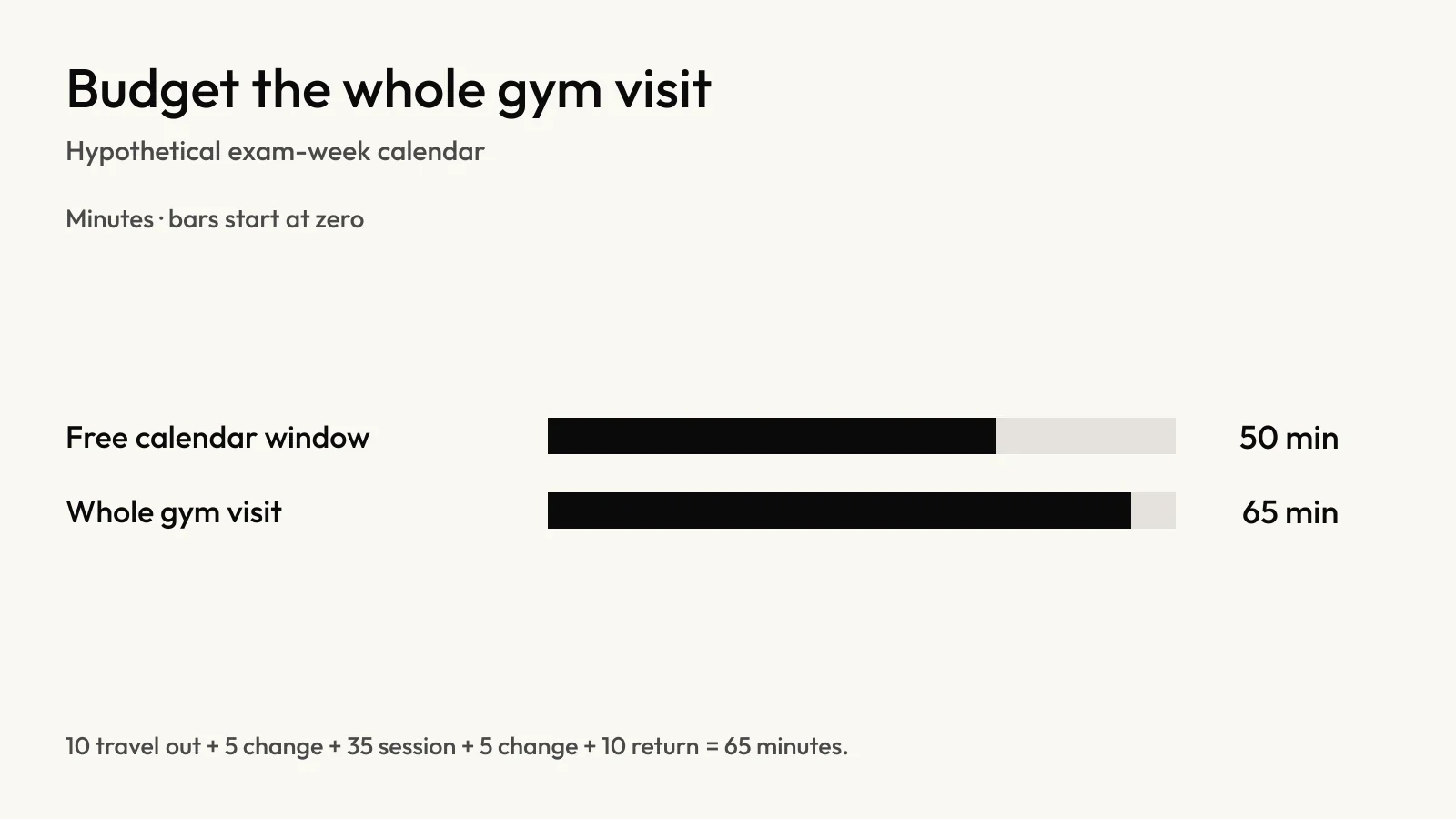
Budget the whole gym visit
Hypothetical exam-week calendar
Minutes · bars start at zero
- Free calendar window50 min
- Whole gym visit65 min
10 travel out + 5 change + 35 session + 5 change + 10 return = 65 minutes.
What goes in the calendar before training?
Enter the fixed exam commitments and the time you need around them. Add travel, entry requirements, meals and your usual sleep before calling an empty box a workout window.
Check the actual start and finish times for each paper. A 09:00 exam can require an earlier arrival and a trip you cannot shorten. A practical exam, viva or resit may use a different location from your usual lecture room. Keep those details beside the date.
Next, identify a free period with a start and an end. “Tuesday afternoon” is too vague if the library booking ends at 16:00 and you need to leave for a meal at 17:00. A defined window lets you decide whether to visit the gym, choose a familiar local option or leave training out.
How much time does a gym visit need?
Count the whole visit from leaving to returning. A workout that fits inside the window can still produce a late return once you add travel and changing.
| Task | Minutes |
|---|---|
| Travel to the gym | 10 |
| Change before training | 5 |
| Familiar session, including warm-up | 35 |
| Change afterwards | 5 |
| Return trip | 10 |
| Whole visit | 65 |
Method: 10 + 5 + 35 + 5 + 10 = 65 minutes. In a fifty-minute window, this visit is fifteen minutes too long. The inputs are chosen examples; substitute your actual trip and allow for queues or delays.
A shorter session is useful only if the whole revised visit fits. Use the workout-shortening method to name what you defer. Keep your warm-up and necessary rests in the budget instead of compressing them until the numbers appear to work.
What should you do with zero, one or two free windows?
Let the calendar decide how many visits are feasible. A temporary week can contain fewer sessions than your usual programme, including none.
| Available windows | Example choice | What to record |
|---|---|---|
| None | Take the training break; keep ordinary movement that fits | The first sensible return date |
| One | One familiar session that fits the entire window | Which planned work you completed and deferred |
| Two | Two familiar sessions on separate suitable days | The actual exercise and set record for each |
This is a decision table, not a claim that all three options preserve exactly the same fitness. Avoid starting a new demanding routine to compensate for having fewer visits. A week with less training is easier to interpret when you keep the familiar exercises and record what you did.
If you choose two visits, the twice-weekly training article explains how session frequency and weekly sets differ. It does not require you to fit two visits into an exam timetable that has room for one.
What could a week with Monday and Thursday exams look like?
Reserve the examination days first, then place optional training in the remaining windows. The following adult student’s week is hypothetical and assumes the student already knows the selected exercises.
| Day | Fixed constraint | Training decision |
|---|---|---|
| Monday | Morning exam; travel and preparation | No gym visit planned |
| Tuesday | A confirmed 75-minute door-to-door window | One familiar session, ending on time |
| Wednesday | Preparation for Thursday paper | No gym visit planned |
| Thursday | Afternoon exam | No gym visit planned |
| Friday | Evening travel home | No gym visit planned |
| Saturday | A confirmed 75-minute window | Second familiar session if circumstances still fit |
| Sunday | Prepare the next week | Review return to the usual schedule |
The two 75-minute windows can contain the example 65-minute visit, leaving ten minutes each as a buffer. That calculation does not guarantee a queue-free gym or establish an optimal weekly programme. You can change or cancel a visit if the window disappears.
Use a session you already know rather than copying a stranger’s exercise list during a busy week. If you need to choose a new programme or learn a lift, arrange that with a qualified coach outside this temporary calendar decision.
The day before a paper, keep any session familiar and finish it early enough that the evening’s meals, travel and usual sleep still fit. On the morning of a paper, the exam and the trip to it come first; leave training out if it would make you rush.
Will a lighter week erase your training progress?
A short reduction does not justify a precise prediction about your body. Reduced-training research supports taking the question seriously without treating every missed session as a reset.
Bickel and colleagues’ 2011 study trained 70 young and older adults for sixteen weeks, then studied reduced training or detraining for thirty-two weeks. Age and the adaptation measured affected the result; findings in younger adults do not establish the same muscle-size response for older adults. Those months differ from a seven-day exam timetable. Read the reduced-dose trial.
Spiering and colleagues’ 2021 narrative review reports that, in younger populations, strength and muscle size can be maintained for up to 32 weeks with as little as one strength session a week and one set per exercise, as long as the relative load is maintained. For older populations it says up to two sessions a week and two to three sets per exercise may be needed to maintain muscle size. Those periods are far longer than an exam week, so the review offers context rather than proof that one particular exam-week schedule will maintain every outcome. For the narrower question of one week completely away, read the week-off-gym evidence and its limits.
What if an exam moves or a revision session runs late?
Recheck the remaining windows and remove the visit that no longer fits. Move it only if another complete window exists.
Suppose Tuesday’s 75-minute window falls to fifty minutes. The original 65-minute visit no longer fits. You can choose an appropriate familiar shorter option that fits door to door, or leave the visit out. Writing “missed” beside it does not create time on Wednesday.
Keep a simple return rule: continue from the next sensible planned session rather than doing two hard sessions back to back to repay the calendar. Record the actual work, then use the progression guide for load decisions. The timetable alone cannot establish that you should add weight or sets.
Do short movement breaks count as a workout?
Short movement breaks count as movement, with their own duration and effort. Keep a walk between revision blocks separate from a completed lifting session in your record.
The NHS advises adults to break up long periods of sitting with activity. A short walk to refill water or a comfortable change of position can fit that general advice. This article does not claim that a specific break improves marks, memory or exam performance. Read the NHS adult activity guidance.
Keep the choice practical for the setting. In a library, use an appropriate route and respect other readers. At home, choose familiar movement that suits the space. Avoid turning each break into a hard circuit that changes the training week you intended to reduce.
How do you return after the last exam?
Check the next day’s circumstances, then return through a familiar session you can complete. The end of the last paper does not remove travel, sleep or other commitments from the calendar.
Record any sessions you completed during the week and identify the first usual slot you can attend. If you feel ready to resume, use your current ability and a sensible prescription rather than treating the previous planned load as an obligation. The effort-rating guide can help you describe a set to a coach.
This page gives general planning information for adults. Speak to a GP before changing exercise if you have medical conditions or concerns or have not exercised for some time, as the NHS advises. Students under eighteen need age-appropriate guidance rather than applying adult research ranges as their own programme.
Which sources support this answer?
Training-reduction research explains why a temporary change deserves a measured approach. It does not test this exact exam-week calendar or promise academic or fitness outcomes. The timetable and budgets are illustrative.
- Bickel CS, Cross JM and Bamman MM (2011). Exercise dosing to retain resistance training adaptations in young and older adults. Seventy adults; a 16-week training phase followed by 32 weeks of reduced training or detraining.
- Spiering BA et al. (2021). Maintaining Physical Performance: The Minimal Dose of Exercise Needed to Preserve Endurance and Strength Over Time. Narrative review of reduced-training evidence.
- NHS (reviewed 22 May 2024). Physical activity guidelines for adults aged 19 to 64, including when to seek individual medical advice.
Topic: Exercise during examinations. A temporary training calendar around examination dates, travel and a return to the usual routine.
For training and meals planned together, Download for iPhone.
Liftor is not a doctor and gives no medical advice.